

Local SEO for Gyms and Fitness Studios in San Francisco
Short answer: local SEO for gyms starts with an accurate Google Business Profile. Use your real gym name, the most specific category, correct hours and reviews earned within Google’s rules. This guide walks a San Francisco gym, yoga studio or fitness center through each step. It sticks to Google’s own guidelines and makes no ranking promises or fitness claims.
To see how we help San Francisco businesses get found, visit our local SEO service in San Francisco page. If you are new to the basics, start with our guide to local SEO for small businesses.
How Local SEO Helps People Find Gyms
A fitness business has two places to be found: the Google Business Profile (GBP) and the website it links to. Picture the profile as the chalkboard by the front door and the website as the full class binder. The chalkboard answers quick questions: where is the space, is it open now, and what kind of gym is it? The binder holds the detail.
A search such as “gym near me” shows local intent: the person wants a space close by. Whatever shows in local search should match what members see at your door, so keep your facts easy to read in local search results. Search engine optimization (SEO) keeps the profile and site in step, so Google and members read the same facts.
Write your pages for yoga fans and other fitness enthusiasts in everyday words, such as “yoga class” or “boxing gym,” not internal program names. These plain fitness keywords belong on your pages, never in your business name. Nobody can promise a spot in the local pack or a better local ranking, and this guide does not. You control accuracy, and that is where good gym SEO begins. A boutique fitness studio, one of the small gyms in town and a larger fitness center follow the same steps.
Set Up Your Gym’s Business Profile the Right Way
Every field on your profile falls under Google’s guidelines for representing your business on Google. Our guide to the Google Business Profile for local businesses covers general setup.
Before you change anything, run a quick SEO audit by hand, and glance at your local competition’s profiles. Put your profile and website side by side and check that the name, address and phone number match. Use the same phone number in both places, then search for your gym name and read the search results the way a new member would. Next, check any listing in local directories, the local chamber of commerce, the local newspaper or the local press. Matching listings elsewhere are called local citations, and building local citations is SEO work only when every one is accurate.
Use Your Real Gym Name, No Keywords
Enter the name on your door, your membership cards and your website. Google says the name should reflect how the business is known in the real world, and extra details are not allowed and could lead to a suspended profile.
Say your studio is called “Harbor Strength.” A name like “Harbor Strength Gym Boxing Yoga SF” breaks the rules twice, with service words and a location. Skip shortcut SEO tactics; this is one of the common SEO mistakes.
Pick the Most Specific Category
Google wants the shortest, most specific category list that fits your core business. Categories are not a place for keywords or feature lists. Ask whether a category says what your gym is, or only something it has.
Google’s own guidelines include a fitness example. A well-known 24-hour fitness brand is listed there as a health club, while “Gym” and “Swimming Pool” are marked as wrong picks. The lesson carries over: a pool, a sauna or a smoothie bar is something your gym has, not what it is.
Hours, Special Hours and Holiday Closures
Google lets you set special hours for holidays or special events. If you close on Thanksgiving or run shorter hours over New Year’s, add it ahead of time. While you are in the profile, confirm your phone number too, and check how your hours look in local search after you save.
Gyms have one twist. Google says businesses with varied hours, such as schedules for different activities or classes, generally should not list hours at all. If members can walk in during set opening times, list those. If your studio only opens for scheduled classes, read that section of the guidelines first.

Should Each Trainer Get a Profile of Their Own?
Google reserves individual profiles for public-facing professionals who have customers of their own. The types it lists include doctors, dentists, lawyers, financial planners, and agents who sell insurance or real estate. Trainers are not on that list, so read the wording before you create anything, even if your gym is known for fitness coaching.
Google adds conditions. The person should be public-facing and reachable at the verified location during stated hours. Staff who only support the work, such as the front desk team, do not get profiles of their own. If several practitioners share one location, the business keeps its own profile, and each practitioner’s profile carries only that person’s name. Our post on local SEO for chiropractors shows a clinic example. Google also warns against separate profiles for each specialization, so a gym with yoga and boxing keeps one. For most gyms, one profile is the safe default.
Local SEO for Gyms: Pages for Each Class and Program
Give each main class its own page instead of one “Classes” page that lumps spin, yoga, strength and boxing together. Only build pages for what you really run. Each page for your fitness classes can use local keywords in plain words, such as the class name and your neighborhood.
On-page SEO here is simple. Give each page a clear title and headings, then explain what happens in a session, who it suits and how to book. If you run spaces in more than one part of the city, our guide to neighborhood pages in San Francisco explains how to give each location its own page.
On the technical SEO side, Google’s LocalBusiness structured data guide lists name and address as required and asks for the most specific business type possible. Our local business schema guide shows how to add it.
Photos That Show Your Real Space
Add real photos of your entrance, floor, studio rooms, fitness equipment and locker area, down to the cubbies by the shoe rack.

Use your own photos, not stock images. Ask members before you post any photo showing their face.
Local SEO Reviews for Gyms: What Google Allows
Google’s prohibited and restricted content policy sets clear limits on how a gym can ask for reviews.
- You can invite members to share a genuine experience, if nothing is offered in return and you do not shape the rating.
- Never trade a class pass, a discounted month or a T-shirt for a review.
- Ask everyone, not just happy members. Google does not allow selectively asking for positive reviews or discouraging negative ones.
- No pressure at the front desk, no review quotas for coaches and no requests for reviews that name a coach.
- Reviews from current or former coaches, staff or family count as a conflict of interest.
Our Google reviews strategy guide covers replies and follow-up.
Local SEO for Gyms: Mistakes to Avoid
Keep SEO for your gym simple. Use this as a short SEO checklist, and treat it as a plain SEO guide:
- Adding “gym” or a neighborhood to the business name.
- Picking categories for things the gym has, like a pool or steam room.
- Leaving holiday closures off the profile.
- Making trainer profiles without checking Google’s wording.
- Trading free classes for reviews, or only asking happy members.
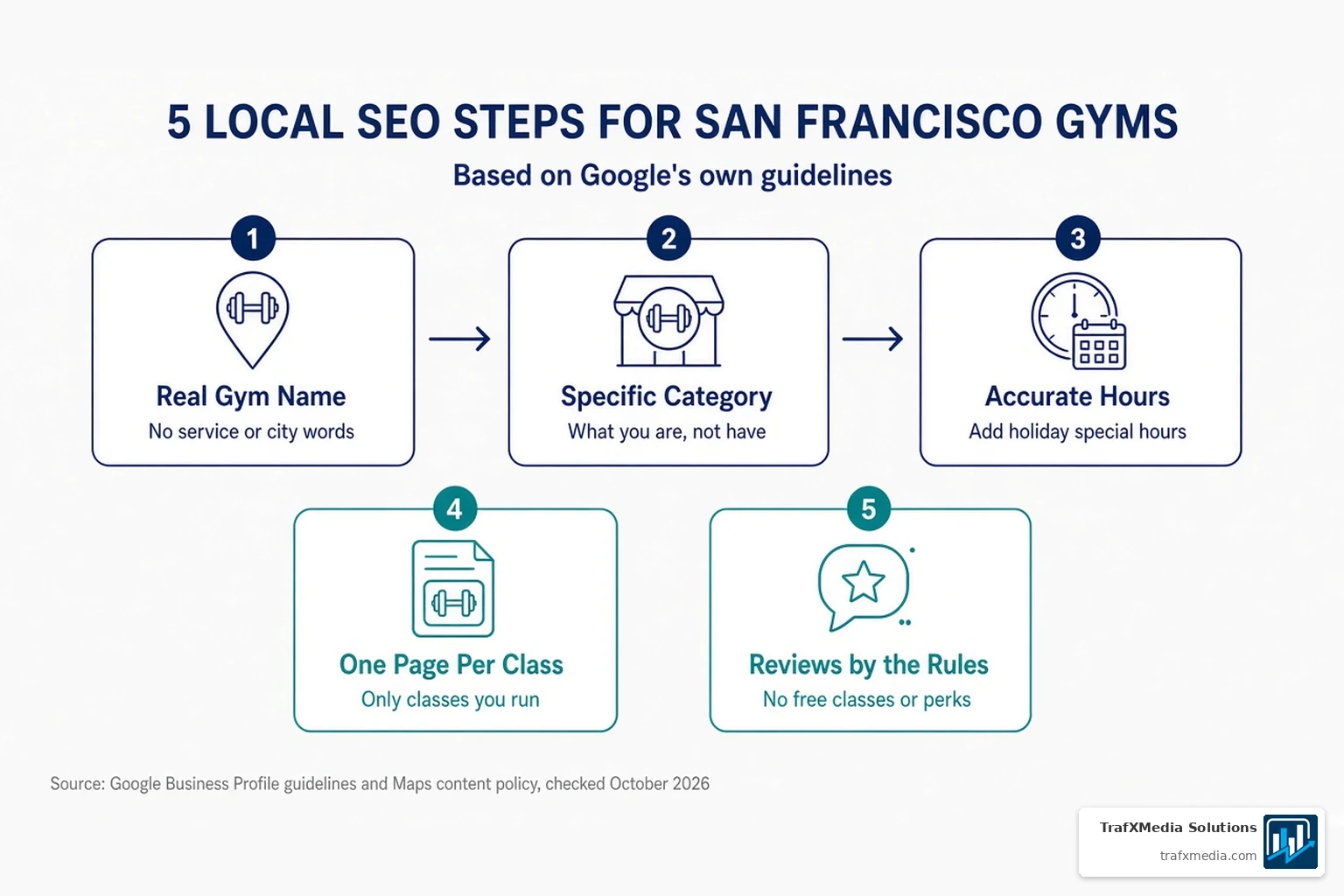
A strong SEO strategy for a gym is mostly careful housekeeping, and no one can promise local visibility in search results.
Frequently Asked Questions About Local SEO for Gyms
Can I Add “Gym” or “San Francisco” to My Business Name on Google?
Google does not permit it. It counts service and location words as extra information, so stick to the name on your door.
Does Each of My Trainers Need a Listing?
Not by default. Google’s practitioner examples leave trainers out, so check its wording before you set one up.
Which Category Should a Fitness or Yoga Studio Choose?
Pick the one that names what your space is, not a feature like a pool, and keep the list short.
Is a Free Class a Fair Thank-You for a Review?
Google says no to that kind of thank-you. Payment, discounts and free services given for a review all count as incentives.
Should I Set Special Hours for Holidays?
Yes, if you list opening hours. Google lets you set special hours for holidays and special events.
Want help to attract local members to your San Francisco gym or studio? TrafXMedia Solutions can show you where to start with SEO for gyms and fitness studios. Contact us to talk it through.