
Local SEO for Hair Salons in San Francisco: Get Booked From Google Maps
When someone wants a fresh cut in San Francisco before a big weekend, the search usually starts on a phone. They type “best hair salon near me” or “barbershop in Noe Valley” into a search engine and pick from the shops Google shows first. This local SEO playbook explains local SEO for hair salons in plain terms: what a salon owner can set up, what Google’s own rules say, and which shortcuts can get a profile in trouble.
For the bigger picture of how we help San Francisco business owners get found, see our local SEO service in San Francisco page.
Local SEO for Hair Salons: How Local Clients Find You
When someone searches for a salon, they rarely use a name. They type beauty services like “best balayage in the Mission” or “fade near me.” For local search like this, Google can show a map with a few nearby salons above the regular local search results. Unlike Google Ads, these spots are not bought. A beauty salon has two chances to show up: the Google Business Profile (GBP), once called Google My Business, and the salon website it links to.
The profile answers quick questions like where the salon is and whether it is open today. The website shows the detail. Salon search engine optimization is the work of making the website and local profile tell the same story, so your search ranking and visibility in Google Search rest on facts that match.
Salon clients say “just a trim,” not the terms on your price list. The best keywords are the local words clients are searching with, so use them on your pages. That keyword targeting is the base of sound SEO practices and organic SEO. Our guide to the Google Map Pack in San Francisco explains the map results in more depth. Salon marketing on social channels is a separate track; read our post on Facebook marketing for salons for that side.
Set Up Your Salon’s Business Profile the Right Way
For many new clients, your GBP panel is their first look at the salon. Every field on it falls under Google’s guidelines for representing your business on Google. Our guide to the Google Business Profile for local businesses covers general setup.
Use Your Real Salon Name, No Keywords
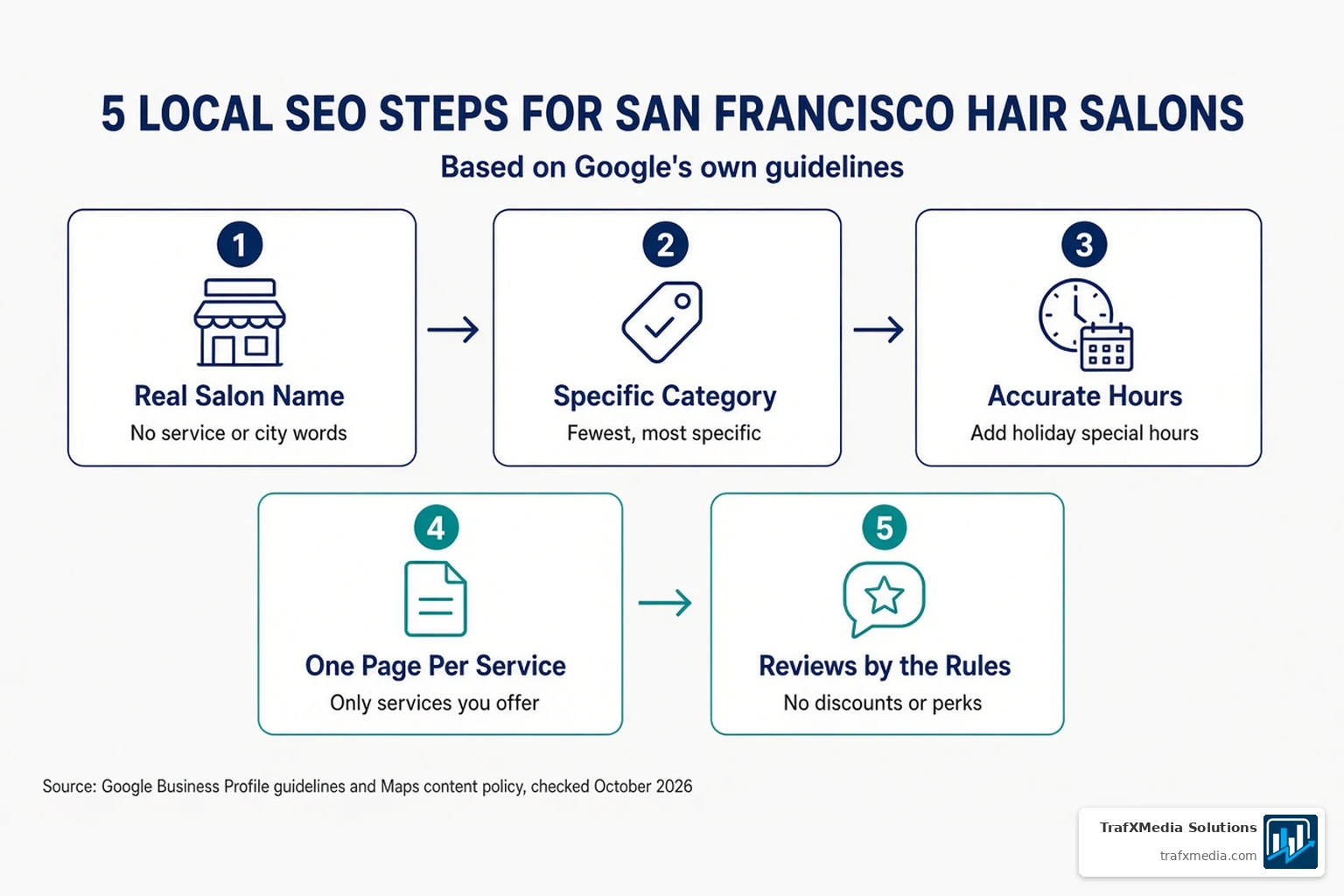
Use the name on your window and appointment cards. Google says the name should match how the business is known in the real world. It also says extra details in the name are not allowed and could lead to a suspended profile.
Say your salon is called “Marigold Studio.” A name like “Marigold Studio Hair Color and Blowouts SF” breaks the rules twice, once with service words and once with a location.
Pick the Most Specific Category
Google asks for as few categories as possible, each as specific as possible. A handy check for salons: the category should say what your shop is, not list what your chairs offer.
A barbershop that mostly does fades and hot towel shaves may find a tighter fit than “Hair salon” in the category list. Your color, hair extensions and hair styling work belong in your services and on your website, not in extra categories.
Business Hours, Special Hours and Holiday Closures
List the business hours when clients can actually walk in or book an appointment. Your profile has a special hours field for days when the salon runs a different schedule, like a holiday or a late styling night. If you open late before New Year’s Eve or close for a holiday, add it ahead of time. Your salon’s details should read the same everywhere it is listed, from booking apps to a local chamber of commerce listing.

Should Stylists Get Their Own Google Profiles?
Google does allow separate profiles for some individual professionals, but its idea of who qualifies is narrow. It has in mind a person clients seek out by name, who keeps their own client list and can be reached at a verified address. Hair professionals are not named in Google’s examples, so compare the current wording with how each team member works first.
A chair renter with a loyal client book may look different from a junior hair professional who takes walk-ins. Front desk and assistant roles should never get a profile. If a practitioner does qualify, the salon still keeps its own profile, and that person’s profile carries only their personal name, not the salon’s.
The safe default is one strong profile for the salon.
On-Page SEO for Salons: Cuts, Color and More
One “Services” page that lists cuts, color and styling in a single paragraph gives Google little to match. A page for each main service answers each search better. A balayage salon should have a page for balayage, plus pages for curly hair cuts, color and styling, but only for services your salon really offers.
Each page should answer real client questions in everyday words: what the service involves, how a first visit works, and how to book. That is a simple SEO content strategy, and it builds trust with potential clients. Good on-page optimization also means a clear title and a meta description that says what the page covers. If you serve clients from several parts of the city, our guide to neighborhood pages in San Francisco explains how to handle that without thin copies.
Google’s guidelines also allow a services menu on the profile for businesses like barbers and spas. It should list the full set of services, not just popular ones. For technical SEO, Google’s LocalBusiness structured data guide lists name and address as required and asks for the most specific business type possible. Our local business schema guide shows how to add it.
Photos That Show Your Real Salon
New clients want to know what the space feels like before they book. Real photos of your entrance, chairs, wash stations and team answer that, so a new client knows the number of chairs, the vibe and where to go before they book.
Skip stock images. Ask clients before you post any photo that shows their face.
Local SEO Reviews for Hair Salons: What Google Allows
Client reviews matter to people choosing a salon, and Google’s prohibited and restricted content policy sets clear limits on how you can ask for them.
- You can invite clients to share a genuine experience, as long as nothing is offered in return and you do not try to shape the rating.
- No discounts on the next cut, free add-ons or product samples in exchange for a review.
- Do not ask only the clients who loved their color. Google does not allow merchants to selectively ask for positive reviews or discourage negative reviews.
- Do not press clients to review while they are still in the chair, and do not give staff review quotas or ask for reviews that name a team member.
- Reviews from current or former staff or family members count as a conflict of interest.
A simple habit works: after checkout, send every client the same short text with a link to your Google review form. Our Google reviews strategy guide covers replies and follow-up.
Salon SEO Strategy Mistakes to Avoid
Every salon owner should prioritize avoiding these common slips in 2026:
- Adding service words or a neighborhood to the business name on Google.
- Stacking categories for every service on the menu.
- Forgetting to post your Thanksgiving or New Year’s hours.
- Setting up a profile for every chair renter on the floor.
- Trading a free deep conditioning for a five-star review.
- Writing service pages once and never updating them.
Salon Owner Questions on Local SEO for Hair Salons
Can My Salon’s Google Name Include “Hair Salon” or a Neighborhood?
Keep those words out of the name. Google treats service and location words in the name as extra information, which is not allowed and could lead to suspension. Use your real salon name.
Should Each Stylist at My Salon Have a Separate Profile?
Most salons are better off with one profile. Google’s rules for individual professionals are narrow, and stylists are not among its examples, so read the current wording before setting one up.
Which Category Fits a Salon Best?
Choose the most specific category that describes your main business and keep the list short. Treat categories as a label for the shop, not a place for extra search terms.
Can My Salon Trade a Free Service for a Google Review?
That trade breaks Google’s rules. Payment, discounts or free services in exchange for a review are not allowed.
Is There a Shortcut to Getting More Clients From Search?
Growing the number of clients takes steady SEO efforts, not shortcuts. Accurate profile details, real service pages and honest reviews are what Google’s guidelines ask for, and results usually take months of consistent work.
Want to optimize your San Francisco salon or barbershop and focus on attracting new clients and local bookings from search? Contact us to talk it through.