

Local SEO for Accountants in San Francisco: How CPA Firms Get Found on Google
When a San Francisco business owner needs help with the books, or a family wants someone to look over their paperwork, the search usually starts on a phone. They type “accountant near me” or “tax accountant in SoMa” and pick from the firms Google shows first. This guide explains local SEO for accountants in plain terms: what a San Francisco accounting firm can set up, what Google’s own rules say, and which shortcuts tend to cause trouble. It makes no ranking promises, and it gives no tax or accounting advice.
For the wider picture of how we help San Francisco businesses get found, see our local SEO service in San Francisco page.
How Local SEO Helps Clients Find Accountants on Google
Few potential clients start with a firm name in mind. A café owner in the Mission usually types the problem plus a neighborhood. For local searches like these, Google can show a map with a handful of profiles first and regular search results underneath. Your firm earns visibility in two spots: the Google Business Profile (GBP) and the website it points to.
Treat those two spots as partners. The profile answers the quick questions: where is the office, is it open, and what kind of firm is it? The website covers the rest. Search engine optimization (SEO) is the work of making both tell one story, which keeps your online presence steady.
Listen to how new clients phrase things on the first call. A small business owner might say “I need someone for my books,” not “outsourced accounting.” Someone else asks for a “bookkeeper near Union Square” or “business advisory for a startup.” Borrow those exact phrases for page copy, since that is how people type them into a search bar.
Ads work on a different track from everything in this guide. For that side of things, read our post on Google Ads for accountants.
Set Up Your Firm’s Business Profile the Right Way
For many prospective clients, the GBP panel is their first look at your practice. Every field on it is covered by Google’s guidelines for representing your business on Google. General setup steps live in our guide to the Google Business Profile for local businesses. The notes below stick to what is different for CPA firms and bookkeepers.
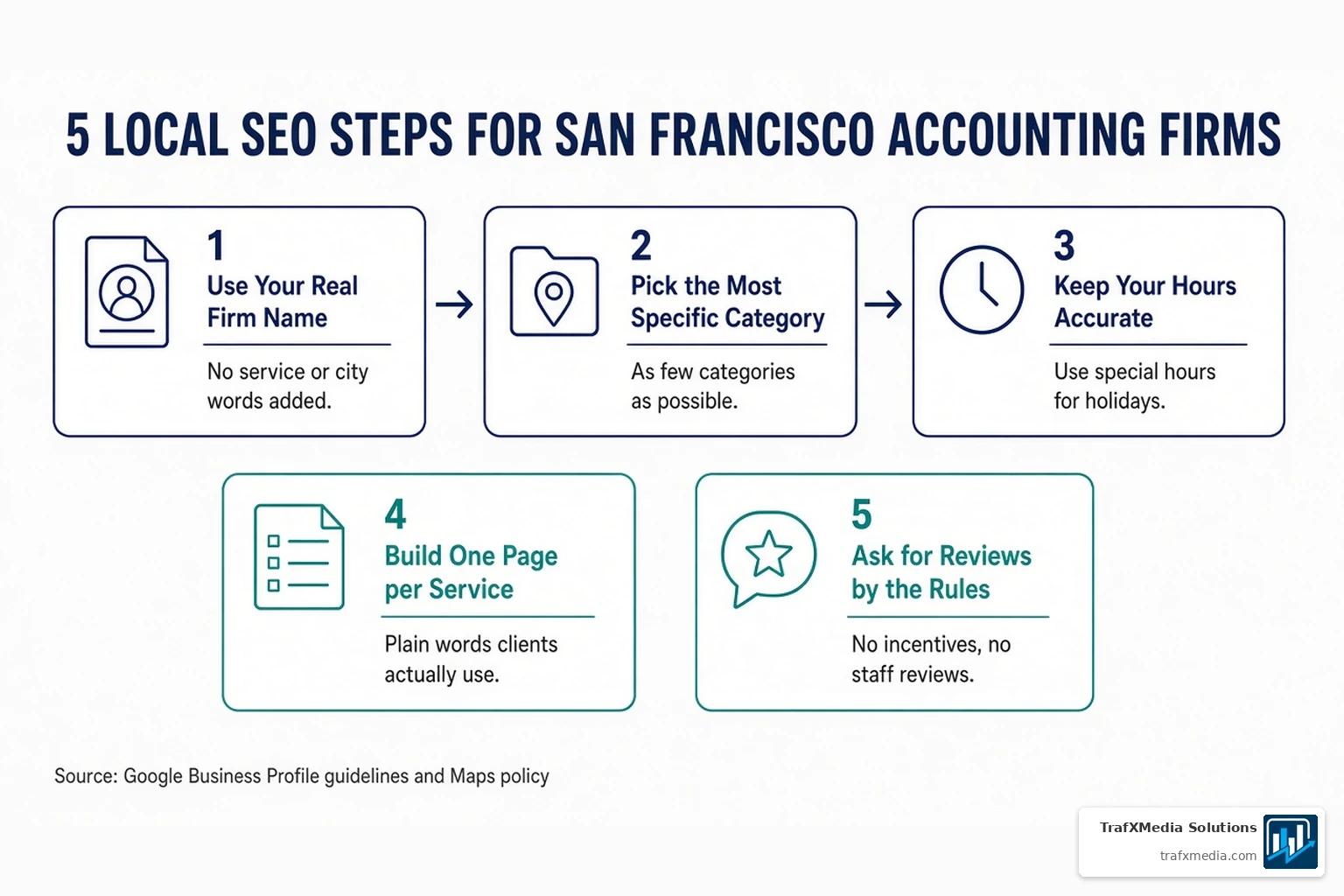
Use Your Real Firm Name, No Keywords
Write the firm name as it appears on your engagement letters and office door, the name clients already know. Google also warns that padding a name with extra details is against the rules and can get the profile suspended.
Picture a practice called “Rivera and Chen.” Listing it as “Rivera and Chen Tax Preparation San Francisco” breaks that rule. If a word is printed on your letterhead as part of the name, keep it. Do not add words to match searches. Your street address already tells Google you are in San Francisco. If a profile has already been suspended, our post on fixing a suspended Google Business Profile walks through recovery.
Pick the Most Specific Category
Ask yourself what most clients hire you for. A tax return practice and a monthly bookkeeping shop may fit different labels. Google wants the fewest labels that honestly describe your core work, each one as narrow as it can be while still accurate. Labels are not a place for keywords.
To optimize the profile, scroll the full category list and choose the closest match for your main line of work. Only add another if that service brings in clients week after week, not once a year.
Hours, Special Hours and Tax Season Changes
Google lets you list your current seasonal schedule as your normal hours, so longer evenings in busy months can appear there. Separate special hours cover single days, such as holidays or a closure for a staff event.
When the rush ends and you go back to shorter days, change the profile the same week.

Firm or Individual Profiles: Local SEO Choices for Accountants
Google treats certain public-facing professionals with their own book of clients as individual practitioners, and it lists financial planners among its examples. A practitioner profile may show a title or degree certification after the name.
If several of those professionals meet clients at one office, the guidelines call for a firm profile for the location plus a separate one per practitioner. Each practitioner profile carries only that person’s name, without the firm’s. Support staff do not get one.
In practice, a three-partner firm where every partner has their own client list could run four profiles in total. A solo practitioner working under a branded firm follows a different section of the same page, so read it before you set anything up. Other professional services face this choice too, and our guide to local SEO for lawyers in San Francisco shows a similar setup.
Local SEO Service Pages for Accountants
Give each main service its own page, such as bookkeeping, business tax returns, personal tax returns or payroll, but only for services you actually offer. On each page, say who it suits, walk through how an engagement runs and end with a clear next step. This on-page work is where you can stand out.
Explain your process, not tax rules. Show your firm name, address and office hours exactly as they read on your profile and on any directory listing. Checking each listing once a year, perhaps right after the busy season, can catch an office move the directory never heard about.
Behind the scenes, a firm can also mark up its address and name in code so search engines parse them cleanly. Google’s LocalBusiness structured data guide lists the address as a required property and recommends the most specific LocalBusiness sub-type possible. Our post on local business schema in San Francisco explains the basics.
Client Reviews for Accounting Firms: What Google Allows
Before sharing a W-2 or a profit and loss statement with a stranger, most people want proof that others felt safe doing it. Fake engagement gets removed under Google’s prohibited and restricted content policy. That means no fee discount or free consultation in exchange for a review, and no reviews tied to a conflict of interest, so current or former staff should not post one (policy read October 2026).
A clean habit for a firm: when a return is filed or a year-end package is delivered, send every client the same short note with your review link. Do not filter out clients who might be lukewarm, and never tie the request to a reduced invoice. In replies, never mention returns or balances. Our Google reviews strategy for San Francisco businesses goes deeper.

Local SEO for Accountants: Mistakes to Avoid
Most SEO problems come from shortcuts that look helpful at first. Here are the ones to steer clear of:
- Stuffing the business name. Padding the firm name with services or the city name breaks Google’s rules and risks suspension.
- Too many categories. Pick the most specific category that fits your main work, and add others only when they are real.
- Stale hours. Update hours when your schedule changes, and use special hours for holidays.
- Profiles for support staff. Only public-facing practitioners should have their own profiles.
- Buying or trading reviews. Incentives and conflict-of-interest reviews are prohibited.
- Thin website pages. One vague page for every service gives clients little reason to call.
- Chasing backlinks first. Links from other sites can help SEO, but they will not fix an inaccurate profile.
Frequently Asked Questions
Can I Add “CPA” or “San Francisco” to My Business Name on Google?
That depends on what your sign and letterhead already say. Extra words added only for search break Google’s naming rules, and the profile can be suspended for them. City words belong in the address, not the name.
Should Each Accountant at a Firm Have a Separate Profile?
Google’s guidelines allow public-facing practitioners with their own clients to have a dedicated profile, separate from the firm’s. Support staff should not have one. Check the practitioner section of Google’s guidelines before you set this up.
Which Category Helps Local SEO for Accountants?
Google asks for as few categories as possible, as specific as possible, that represent your main business. Choose the one that matches the work most clients hire you for.
How Do Accounting Firms Get More Reviews Without Breaking Rules?
Ask every client the same way after their work is done, and make it easy. Do not offer anything in return, and do not collect reviews from staff.
Can I Change My Hours During Tax Season?
Yes. Google lets you use current seasonal hours as your regular hours and set special hours for particular days.
Want help with your firm’s SEO? TrafXMedia Solutions works with San Francisco businesses on local SEO that follows Google’s rules. Contact us to talk about your accounting firm.