
Local SEO for Insurance Agents in San Francisco: How Agencies Get Found on Google
Short answer: local SEO for insurance agents starts with one accurate Google Business Profile for your office. Then you choose the right profile type for agency or agent, build website pages that match your real office and gather reviews the way Google allows. This guide is for San Francisco agency owners, independent agents, insurance brokers and any life insurance agent who meets local clients at an office. It offers local SEO tips for insurance agents in 2026, drawn from Google’s published guidelines, with no SEO ranking, lead or timeline promises. For the bigger picture, see our local SEO services in San Francisco.
Local SEO for Insurance Agents: How Clients Find You on Google
When someone in San Francisco runs a local search such as “insurance agent near me,” they want a real office, a real name and details they can trust. Local SEO is the part of digital marketing that helps build local search visibility by keeping those details correct wherever a search engine or a person sees them. Four places matter most: your profile, your website, other listings and your reviews.
This SEO work is organic search, with no ad spend. We promise no organic traffic, and it is not a lead generation shortcut. Google’s Search Status Dashboard, checked November 2, 2026, listed no current incidents.
Set Up Your Agency’s Business Profile the Right Way
Our walkthrough of the Google Business Profile for local businesses covers general setup, so this section sticks to what matters for an agency. Google’s guidelines for representing your business are the rulebook. Let them shape your local SEO strategies for insurance, and open them before you change anything.

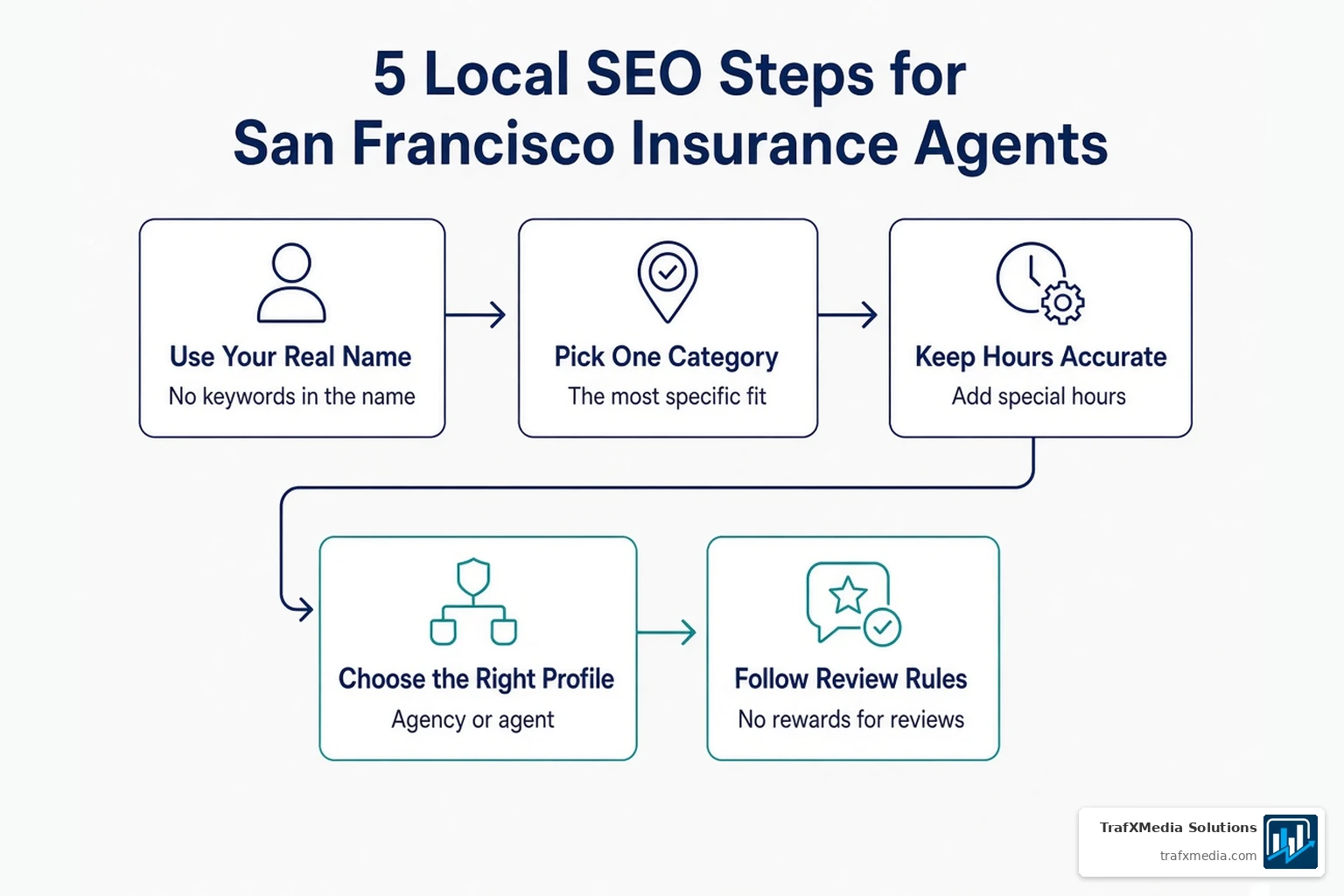
Use Your Real Agency Name, No Keywords
Your profile name should be the name on your door, your website and your letterhead. Google lists the extras it does not want in a name, and the list includes taglines, service wording and location wording. Adding them can get a profile suspended. Put your address, hours and category in their own fields instead.
An independent insurance agency with a short name on the door has a short profile name too.
Pick the Most Specific Category
Google asks for as few categories as possible, each one as specific as it can be, and none chosen as a search term. Open the picker and choose the option that best describes what your office does, then stop adding. Stacking categories to optimize your SEO works against Google’s own rule.
Hours, Special Hours and Holiday Closures
List the hours when a client can really walk in or reach someone. Google also lets you set special hours for holidays and special events, so use that instead of changing your weekly schedule.
- Address: a rented mailing address or virtual office does not qualify. A shared workspace can qualify only with clear signage, clients received during business hours and your own staff on site.
- Description: Google does not allow links in it, and it should not be about promotions, prices or offers. Describe your office and who you help in your local market, in plain words.
Agency Profile or Individual Agent Profile?
This is the question independent agencies and agents ask most. Google’s guidelines include a section on individual practitioners, and it names insurance agents among them. We will not restate its conditions, because they are exact and Google can revise them. Read the Individual practitioners section first, then decide.
Whatever you choose, do not open a second profile for the same office to catch more searches. Google asks for no more than one page for each location, and its practitioner section covers the exceptions.
For comparison, see how real estate agents and accountants handle the same choice.
Website Pages That Match Your Real Agency
Your agency website should say what your profile says. Use the same agency name, address and hours on a clear contact page. Add a short page about your insurance business, and a bio page for each agent who meets the public.
Give each line of business you sell its own page, such as life insurance or auto insurance. Explain in plain words how your office helps. Leave out rates, premiums and coverage details. Optimize each page around one real topic, not a list of search words, so it reads well in the search results too.
If you run more than one real office, give each its own page with details that belong to that office. Do not copy one template and swap the neighborhood. Our guide to neighborhood pages in San Francisco shows what a useful page looks like.
The insurance industry brings carrier rules of its own, so on insurance websites, check your carrier’s rules before you publish anything that uses its name or branding.
You can also describe your office with LocalBusiness markup. Its LocalBusiness structured data page lists name and address as required and asks for the most specific subtype available. Our local business schema post goes further.
Citations and Listings for Insurance Agencies
A citation is any mention of your agency’s name, address and phone number, often shortened to NAP, on another site. The goal is boring on purpose: every mention should match your profile letter for letter. A different suite number or an old office name confuses people searching for local insurance and any search engine reading it.
Pick a day to review each listing you control, fix what is off and note where each one lives. A simple spreadsheet is enough, and you do not need paid SEO tools to begin. Our local citations checklist has the full routine, so we will not repeat it here.
Reviews for Insurance Agents: What Google Allows
Google’s review rules are strict. They sit in its prohibited and restricted content policy, which you should read in full. In short, these are the lines to stay behind:
- Never give payment, a discount or a free item in return for a review, or in return for taking a bad one down.
- Never steer the process by discouraging negative reviews or asking only your happiest clients.
- You may ask for honest reviews. Do not pressure anyone to write one at your desk, and do not ask for specific wording.

A simple habit works within those lines. After a client appointment, send a short thank-you with your review link and leave it there. Google’s policy also bars posting private details about others without consent, and it names financial information, so keep client details out of your replies altogether.
For the full approach, read our Google reviews strategy for San Francisco.
Local SEO for Insurance Agents: Mistakes to Avoid
Most insurance SEO problems come from shortcuts. A strategy for insurance should rely on plain accuracy, since the insurance market rewards that over clever tricks. Watch for these:
- Putting “insurance,” a neighborhood or a slogan into the profile name.
- Using a mailing address or virtual office as your location.
- Adding links, offers or prices to the description.
- Offering gifts or discounts for reviews, or sorting who gets asked.
- Letting your name, address or hours differ from page to page.
- Promising clients, or yourself, a fixed result from insurance SEO.
Frequently Asked Questions
Can an Insurance Agent Have a Separate Google Business Profile From the Agency?
Google has a section on individual practitioners, and it names insurance agents. Its conditions are specific, so read the guidelines and follow them exactly rather than relying on a summary.
Can I Add “Insurance” or “San Francisco” to My Business Name on Google?
Only if it is part of your real name as shown on your door and website. Google lists service wording and location wording among the extras to leave out, so do not add them to look better in search.
Which Category Should an Insurance Agency Choose?
Choose the most specific option in Google’s list that fits what your office does, and use as few as you can. Do not choose categories as keywords.
Can I Offer a Gift or Discount for a Review?
No. Google’s policy does not allow payment, discounts or free items in exchange for reviews. You can ask for honest reviews without any reward.
Do I Need My Carrier’s Permission to Set Up a Profile?
Check your carrier’s rules. We cannot say what they require, and Google’s guidelines are a separate matter, so follow both.
How Long Does Local SEO Take?
It varies, and we will not give a timeline. Accurate details, steady reviews and useful pages add up over time, and the pace depends on your office and what you change.
How Do I Measure Local SEO Results?
Write down the date of each change, then ask every new client how they found you and log the answer. Review the log monthly and compare it with the month before.
Want a second pair of eyes on your profile and site? TrafXMedia Solutions can help. Contact us and we will talk it through.