
How Lawyers Can Conquer Facebook Advertising
Why Facebook Ads Are a Game-Changer for Law Firms
In today’s digitally-driven world, Facebook marketing for lawyers has evolved from a novel idea into one of the most powerful and indispensable strategies for attracting new clients and scaling a modern law practice. With a staggering user base exceeding 2.8 billion monthly active users, Facebook provides an unparalleled platform to connect with potential clients in a way that traditional marketing simply cannot match. The fundamental difference lies in its proactive nature. While conventional methods like Yellow Pages or even search engine optimization (SEO) are reactive—waiting for someone to realize they have a legal problem and actively search for a solution—Facebook advertising allows you to get in front of your ideal clients before they even begin their search. You can build awareness, establish trust, and position your firm as the go-to authority, so when a legal need does arise, you are the first name they think of.
This proactive approach is often called “demand generation.” You aren’t just capturing existing demand; you are creating it by educating your audience about their rights and potential legal issues they may not have considered. This is a monumental shift in legal marketing, moving from a crowded, competitive space of active searchers to a vast, untapped market of passive consumers.
Successful Facebook marketing for lawyers is not about random posts or boosting content without a plan. It is a sophisticated discipline built on several core pillars:
- Targeting with Surgical Precision: The true power of Facebook lies in its granular targeting capabilities. You can move beyond basic demographics and reach individuals based on life events (recently married, divorced, new parents, recently moved), interests (pages they like related to business, finance, or specific legal fields), behaviors (small business owners, frequent travelers), and location (down to a specific zip code or a radius around your office). This means a personal injury attorney can target users who have recently visited an emergency room, or a business lawyer can reach administrators of new Facebook business pages.
- Creating Value-Driven, Educational Content: Potential clients on social media are wary of the hard sell. The most effective strategy is to build trust by offering genuine value. This involves creating content that educates, informs, and solves problems. By sharing legal tips, explaining complex legal processes in simple terms, and answering common questions, you position yourself as a helpful expert, not just another advertiser. This content builds a relationship with your audience over time, nurturing them from passive followers into qualified leads.
- Leveraging a Diverse Range of Ad Formats: Facebook is not a one-size-fits-all platform. It offers a rich variety of ad formats, each suited for different campaign objectives. High-impact video ads can be used to tell a compelling story or explain a legal concept. Lead form ads streamline the process for mobile users to request information without ever leaving the app. Carousel ads can showcase multiple practice areas or walk a user through the steps to take after an accident. A successful strategy uses a mix of these formats to keep content fresh and engaging.
- Tracking Real, Tangible Business Results: Likes, comments, and shares are often referred to as “vanity metrics.” While they indicate some level of engagement, they don’t pay your firm’s bills. Effective Facebook marketing for lawyers requires a ruthless focus on actionable metrics that directly correlate with business growth. This means carefully tracking your Cost Per Lead (CPL), the number of qualified consultations booked, and, most importantly, your Cost Per Acquisition (CPA) for each new signed case. This data-driven approach ensures every dollar spent is an investment with a measurable return.
- Adhering Strictly to Ethical and Bar Association Guidelines: As a lawyer, your advertising activities are subject to stringent rules of professional conduct. It is absolutely critical to use clear disclaimers, avoid any language that could be construed as a guarantee of results, and protect client confidentiality at all costs. Navigating these rules is non-negotiable for a sustainable and ethical marketing strategy.
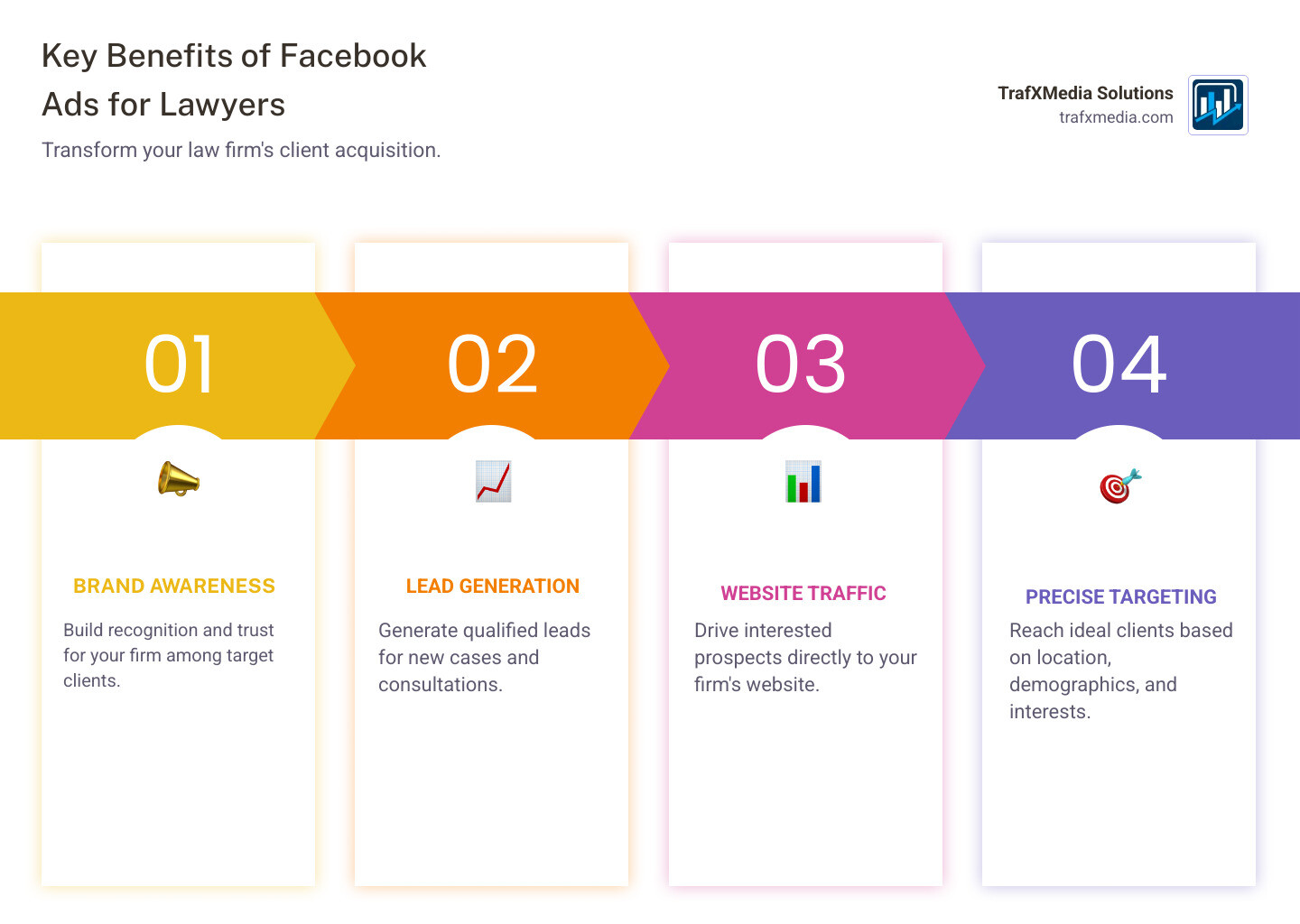
Find more about Facebook marketing for lawyers:
- Local business Facebook marketing
- Facebook marketing agency San Francisco
- Facebook marketing for nonprofits
Understanding the Mechanics: How Facebook Ads Work
At its core, the Facebook Ads platform operates on a highly sophisticated auction system. It’s not as simple as the highest bidder winning. When an ad placement becomes available on a user’s feed, story, or messenger inbox, Facebook’s algorithm instantly runs an auction among all advertisers trying to reach that user. The winner is determined by the “Total Value,” which is a combination of three main factors: the advertiser’s bid, the estimated action rates (the likelihood a user will engage with or convert from the ad), and the overall ad quality and relevance. This system is designed to create a positive experience for the user, meaning high-quality, relevant ads are often rewarded with lower costs and better placement, even if their monetary bid isn’t the highest. The algorithm is constantly learning from user interactions, optimizing ad delivery in real-time to maximize the advertiser’s chosen objective.
The Decisive Advantage Over Traditional Marketing and SEO
When compared to other marketing channels, Facebook Ads present several clear and compelling advantages for law firms. Firstly, they offer the potential for immediate results. A well-configured campaign can begin generating leads and phone calls within 24-48 hours of launch. This stands in stark contrast to SEO, a vital long-term strategy that often requires six months to a year or more to yield significant, consistent traffic and leads.
Secondly, Facebook advertising is remarkably cost-effective, especially when compared to the high cost-per-click rates of competitive legal keywords on Google Ads or the significant investment required for traditional media like television or radio. Facebook allows you to reach a vast, targeted audience for a fraction of the cost, leading to a potentially much lower cost per lead and cost per client acquisition. Furthermore, campaigns are incredibly scalable. Once you identify a winning combination of ad creative, copy, and audience, you can confidently increase your budget to expand your reach and generate more cases, knowing the underlying strategy is sound.
Finally, Facebook Ads uniquely excel at the dual purpose of building long-term brand visibility while simultaneously driving short-term leads. Every ad impression, even if it doesn’t result in an immediate click, contributes to your firm’s brand recognition within your target community. This allows you to connect with and nurture passive candidates—individuals who may need your services in the future but are not actively searching right now. By consistently providing value and staying top-of-mind, you position your firm as the obvious choice when their legal need becomes urgent.
Mastering Facebook Marketing for Lawyers: Your 8-Step Campaign Launchpad
Open uping the full potential of Facebook marketing for lawyers requires a methodical, strategic approach. Launching a campaign without proper preparation is like walking into a courtroom without reviewing the case file—it’s a recipe for wasted resources and disappointing results. This comprehensive 8-step launchpad will guide you through the process of building a high-performance advertising machine for your law firm.
Step 1: Establish Your Professional Foundation
Before you spend a single dollar on ads, you must create a professional and trustworthy hub for your firm on the platform. This begins by setting up a dedicated Meta Business Page at business.facebook.com. This page is your firm’s digital storefront and must be treated with the same professionalism as your physical office. It must be completely separate from any personal profile.
- Complete Every Section: Fill out all available fields in the ‘About’ section, including your firm’s history, mission, practice areas, and contact information. Ensure your address, phone number, and website are accurate and consistent with your other online profiles.
- Optimize Your Visuals: Use a high-resolution, professional headshot for your profile picture, or a clean version of your firm’s logo. Your cover photo is prime real estate; use a high-quality image of your team, your office building, or a branded graphic that communicates your firm’s values.
- Set Up Your Call-to-Action (CTA) Button: Customize the button at the top of your page to align with your primary goal. Options like “Contact Us,” “Call Now,” or “Learn More” can direct visitors to your website or a landing page.
- Cultivate Social Proof: Encourage satisfied clients to leave reviews on your Facebook page. Positive reviews are a powerful trust signal for prospective clients.
Step 2: Define Crystal-Clear Campaign Objectives
What, precisely, do you want to achieve? Every ad campaign must begin with a clearly defined objective. In Facebook Ads Manager, the objective you choose instructs the algorithm on how to optimize your ad delivery. Choosing the right one is critical.
Common objectives for law firms include:
- Awareness: Best for when your goal is to maximize reach and introduce your firm to a broad audience in your target market. This is brand building.
- Traffic: Use this when your primary goal is to drive visitors to a specific page on your website, such as a blog post or a detailed practice area page.
- Engagement: This objective optimizes for likes, comments, and shares. It’s useful for building social proof on a specific post or promoting an event.
- Leads: This is the most common objective for law firms. It optimizes for users to fill out a form, either on Facebook (Lead Form) or on your website, signaling their interest in your services.
- Sales (Conversions): While law firms don’t have traditional e-commerce sales, this objective is used to track specific actions on your website, such as a completed contact form submission or a booked consultation. It requires the Meta Pixel to be properly installed.
Beyond the platform’s objectives, set internal SMART goals (Specific, Measurable, Attainable, Relevant, Time-bound). For example: “Generate 25 qualified leads for our family law practice from a $1,500 ad spend within the next 30 days.”
Step 3: Configure Your Hyper-Targeted Audience
This is where Facebook’s power truly shines. You can move beyond broad generalizations and speak directly to the individuals most likely to need your specific legal services.
- Core Audiences: This is the foundation of your targeting. You build these audiences from scratch based on:
- Location: Target by country, state, city, zip code, or even a one-mile radius around your office.
- Demographics: Target by age, gender, education level, job title, and life events like “Newly engaged,” “Newlywed,” or “Recently moved.”
- Interests: Target people who have shown interest in pages or topics related to your practice area. A family lawyer might target interests like “Divorce” or “Child custody.” An estate planning attorney could target interests like “Financial planning” or “Inheritance.”
- Behaviors: Target based on online activities, such as “Small business owners” for a business lawyer or people who have recently returned from a trip for an injury lawyer.
- Custom Audiences: These are warm audiences of people who already have some familiarity with your firm. You can create them from:
- A customer list: Securely upload a list of past or current clients (ensuring privacy compliance) to either re-engage them or exclude them from new client acquisition campaigns.
- Website visitors: Target people who have visited your website (or specific pages) in a set timeframe (e.g., the last 90 days).
- Engagement: Target users who have liked your page, watched your videos, or engaged with your posts.
- Lookalike Audiences: This is a powerful tool for scaling. You provide Facebook with a source audience (like your best clients or website converters), and it will find new users who share similar characteristics and behaviors. You can create lookalikes of varying sizes, from a 1% match (most similar) to a 10% match (broader reach).
Step 4: Set a Realistic and Strategic Budget
Your budget determines the reach and longevity of your campaign. You can set it at two levels:
- Daily Budget: Sets an average amount to be spent each day. This is good for ongoing, evergreen campaigns.
- Lifetime Budget: Sets a total amount to be spent over the entire duration of the campaign. This is ideal for campaigns with a fixed end date.
You also have a choice in how the budget is managed:
- Campaign Budget Optimization (CBO): You set one overall campaign budget, and Facebook automatically distributes it in real-time to the best-performing ad sets within that campaign.
- Ad Set Budget Optimization (ABO): You manually set a separate budget for each ad set, giving you more control over how much is spent on specific audiences.
Start with a modest test budget to gather data and identify what works. A budget of $25-$50 per day is often sufficient for this initial testing phase. Once you have a proven ad with a positive Return on Investment (ROI), you can confidently scale the budget up.
Step 5: Craft Compelling Ad Creatives and Copy
Your ad creative (the image or video) and copy (the text) are what will stop a user from scrolling and compel them to take action. For lawyers, the key is to be professional, trustworthy, and client-focused.
- Ad Creatives:
- Images: Avoid generic stock photos. Use high-quality, professional photos of you and your team. Authentic images build trust far more effectively.
- Videos: Video is the most engaging format. Create short (15-60 second) videos explaining a legal concept, answering a common question, or sharing a client success story (with explicit consent). Always include captions, as most users watch videos with the sound off.
- Infographics: Simplify a complex legal process (e.g., the steps in a personal injury claim) into an easy-to-understand visual.
- Ad Copy:
- Use the Pain-Agitate-Solve (PAS) Framework: Start by identifying a Pain point your ideal client is facing (“Worried about the divorce process?”). Agitate that pain by highlighting the consequences (“The complexity can be overwhelming and costly.”). Then, present your firm as the Solve (“Our experienced attorneys guide you every step of the way. Contact us for a confidential consultation.”).
- Speak Clearly: Avoid dense legal jargon. Write in a clear, concise, and empathetic tone.
- Include a Strong Call-to-Action (CTA): Tell the user exactly what you want them to do next: “Download Our Free Guide,” “Schedule a Free Consultation,” or “Learn More on Our Website.”
Step 6: Build a High-Converting, Dedicated Landing Page
Never send valuable ad traffic to your website’s homepage. A homepage has too many distractions and is not optimized for a single goal. Instead, create dedicated landing pages for each campaign. A strong landing page for a law firm must:
- Be Mobile-First: The majority of Facebook users are on mobile devices. Your page must load quickly and be easy to steer on a small screen.
- Match the Ad: The headline, messaging, and imagery on the landing page should be a seamless continuation of the ad that brought the user there.
- Have a Clear and Compelling Headline: The headline should reiterate the value proposition and grab the visitor’s attention.
- Feature Abundant Trust Signals: Include client testimonials, case results (where ethically permissible), awards, and logos of bar associations or publications you’ve been featured in.
- Contain a Simple, User-Friendly Form: Only ask for the essential information needed to qualify the lead (e.g., Name, Email, Phone, Brief Description of Issue). Long, complicated forms kill conversion rates.
Step 7: Install and Configure the Meta Pixel
The Meta Pixel is a small snippet of code that you install on your website. It is the brain of your advertising operation and is absolutely essential for success. The Pixel allows you to:
- Track Conversions: It reports back to Ads Manager when a user who clicked your ad takes a desired action on your site, like submitting a form. This is how you measure your CPL and ROI.
- Optimize Ad Delivery: By feeding conversion data back to Facebook, the algorithm learns what kind of users are most likely to convert and will show your ads to more people like them.
- Build Powerful Retargeting Audiences: The Pixel allows you to create custom audiences of people who visited specific pages on your site but did not convert, so you can show them different ads to bring them back.
Without the Pixel, you are flying blind, unable to measure your campaign’s true performance.
Step 8: Launch, Monitor, Analyze, and Optimize
Launching the campaign is just the beginning. Effective Facebook marketing is a continuous cycle of monitoring and optimization. In your Ads Manager dashboard, keep a close eye on key metrics like Cost Per Lead (CPL), Click-Through Rate (CTR), and Frequency.
- Analyze Performance: Regularly review which ads, audiences, and placements are performing best. Look for trends.
- Pause Underperformers: Don’t be afraid to turn off ads that are not delivering results. This protects your budget and allows you to reallocate funds to winners.
- Scale Winners: When an ad is consistently generating high-quality leads at a good price, gradually increase its budget to scale your results.
- A/B Test Everything: Continuously run tests to improve performance. Test different headlines, images, ad copy, and audiences against each other to find the optimal combination. This iterative process of testing and refinement is what separates amateur advertisers from professional, results-driven marketers.
Content Strategies That Build Trust and Generate Cases

The true power of Facebook marketing for lawyers is open uped through strategic content that builds authentic relationships and establishes unwavering trust. On social media, potential clients are not actively shopping for a lawyer in the same way they are on Google. They are scrolling through photos of family and friends, catching up on news, and engaging with their hobbies. A traditional, aggressive sales pitch will be ignored at best and resented at worst. Your content must be a welcome interruption, offering value and empathy during what is often one of the most stressful times of their lives.
The “Generous Expert” Approach to Content
Successful law firms on Facebook adopt the persona of a “Generous Expert” or a “Problem-Solver.” The focus shifts entirely from “Look how great our firm is” to “Here is how we can help you with the problem you’re facing right now.” This client-centric approach means creating content that directly addresses the pain points, fears, and questions of your ideal clients.
For example:
- A personal injury lawyer could create a downloadable PDF, “The 7 Biggest Mistakes to Avoid After a Car Accident,” or a blog post titled, “How to Document Your Injuries for a Stronger Claim.” This content is immediately useful and positions the firm as a helpful authority.
- A family law attorney can develop helpful checklists for gathering financial documents for a divorce, or a video series explaining the differences between mediation and litigation. This demystifies a complex process and builds trust.
- An estate planning lawyer could offer a free guide on “The 5 Essential Documents Every Parent Needs,” generating leads from individuals who may not have realized their need for legal services was so immediate.
- A criminal defense attorney might create content about understanding your rights during a traffic stop or the long-term consequences of a misdemeanor conviction, providing critical information in a moment of need.
This strategy of leading with value builds a pipeline of goodwill. When these individuals eventually need to hire an attorney, your firm will be at the top of their list because you’ve already proven your expertise and willingness to help.
You can also repurpose marketing content for Facebook to maximize your efforts. A single comprehensive blog post can be deconstructed and repurposed into a dozen different social media assets. For instance, a post on “Starting a Business in California” can become:
- A carousel ad showcasing the 5 key legal steps.
- A series of short video tips, with each video covering one step.
- An infographic visualizing the business formation process.
- A text-based post with a quick tip and a link back to the full article.
- A lead magnet (e.g., “The Ultimate Business Startup Checklist”) to capture email addresses.
This approach allows one piece of cornerstone content to fuel your marketing calendar for weeks, ensuring a consistent and valuable presence.
Why Video Content Is Non-Negotiable for Lawyers
In the crowded landscape of a Facebook feed, static images and text can easily be overlooked. Video, however, is dynamic and commands attention. Data consistently shows that video content receives significantly more engagement than other post types. For lawyers, video offers an even more profound benefit: it humanizes you. It allows potential clients to see your face, hear your voice, and get a sense of your personality and demeanor. In a profession often perceived as intimidating, this is an invaluable advantage.
Effective video strategies for law firms include:
- Educational Explainer Videos: Use a whiteboard or simple graphics to break down complex legal topics (e.g., “What is a trust?” or “How does workers’ compensation work?”) into digestible, two-minute videos.
- Authentic Lawyer-on-Camera Tips: You don’t need a Hollywood production studio. Using your smartphone, you can record short, authentic videos sharing a quick tip or answering a frequently asked question. This format feels personal and builds rapport quickly.
- Client Testimonial Videos: A satisfied client speaking on camera is the most powerful form of social proof. (Always obtain explicit, informed consent and ensure you are complying with all ethical rules regarding testimonials).
- Behind-the-Scenes and Firm Culture Content: Showcasing your team, your office, or your firm’s community involvement helps to humanize your practice and allows you to connect with your audience on a more personal level.
Navigating the Minefield of Ethical and Bar Association Rules
While Facebook offers immense opportunity, Facebook marketing for lawyers also carries significant ethical responsibilities. Failure to comply with the rules of professional conduct set forth by your state bar can lead to severe consequences, including disciplinary action. It is not an area to be taken lightly.
Here are critical ethical considerations to keep at the forefront of your strategy:
- Maintain Unwavering Professionalism: Every post, comment, and direct message must uphold the dignity of the legal profession. Avoid overly casual language, political debates, or any content that could be perceived as unprofessional.
- Never Make Guarantees or Misleading Claims: This is one of the most common and dangerous pitfalls. You must never promise or guarantee a specific outcome. Avoid phrases like “We’ll win your case” or “We guarantee the maximum settlement.” Instead, use compliant language like “We’ll fight for the best possible outcome” or “We have a track record of dedicated advocacy.”
- Use Clear and Conspicuous Disclaimers: Most state bars require specific disclaimer language on all advertising materials. This often includes phrases like “This is an advertisement,” “Attorney Advertising,” or “Past results do not guarantee future outcomes.” These disclaimers should be clearly visible within the ad copy or on the landing page.
- Thoroughly Understand Your Specific State Bar’s Rules: Advertising rules vary significantly by jurisdiction. Some states have pre-approval requirements for ads, while others have specific rules about using testimonials or depicting actors. It is your responsibility to know and abide by the rules in the state(s) where you practice.
- Protect Client Confidentiality Above All Else: Never share any details about a client’s case, even in a hypothetical or anonymized way, without their explicit, written consent. Be extremely cautious in comments and messages to avoid inadvertently creating an attorney-client relationship or sharing privileged information.
By building your online reputation on a foundation of transparency, helpfulness, and strict ethical compliance, you can effectively turn followers into clients and trusted referral sources.
Measuring What Matters: From Clicks to Signed Cases
In Facebook marketing for lawyers, it is dangerously easy to get distracted by appealing but ultimately meaningless numbers. These are often called “vanity metrics.” While a post with hundreds of likes or a video with thousands of views might feel like a success, these metrics do not directly correlate with the financial health and growth of your law firm. To build a truly effective and profitable marketing engine, you must shift your focus from what looks good on the surface to the actionable metrics that directly impact your bottom line—turning clicks into consultations and consultations into clients.
Here’s a clear distinction between the metrics to watch and the metrics to largely ignore:
| Vanity Metrics (Feel-Good but Misleading) | Actionable Metrics (Drive Real Business Growth) |
|---|---|
| Likes on a Post or Page | Cost Per Lead (CPL) |
| Total Number of Followers | Lead-to-Consultation Rate |
| Ad Impressions (Reach) | Cost Per Booked Consultation |
| Video Views (without context) | Cost Per Acquisition (CPA) / Cost Per Signed Case |
| Comments and Shares (without conversion) | Conversion Rate (from ad click to lead) |
| Clicks (without context) | Return on Ad Spend (ROAS) |
The Key Performance Indicators (KPIs) That Define Success for Law Firms
To ensure your advertising budget is an investment, not an expense, you must rigorously track a specific set of Key Performance Indicators (KPIs). These are the numbers that tell the true story of your campaign’s performance and guide your optimization efforts.
-
Cost per Lead (CPL): This is the most fundamental metric for any lead generation campaign. It is calculated by dividing your total ad spend by the number of leads generated. Knowing your CPL tells you exactly how much it costs to get a potential client to raise their hand and express interest. This allows you to assess the efficiency of your ads and make informed decisions about your budget.
-
Cost per Acquisition (CPA): Also known as Cost per Retained Case, this is the holy grail of legal marketing metrics. It measures the total marketing cost required to sign a new, paying client. To calculate this, you need to track leads all the way through your intake process. A low and predictable CPA is the ultimate proof that your Facebook advertising is not just working, but is a highly profitable driver of firm growth.
-
Click-Through Rate (CTR): This is the percentage of people who saw your ad and clicked on it. A high CTR is a strong indicator that your ad creative and copy are compelling and resonating with your target audience. While a high CTR alone isn’t enough (you need those clicks to convert), it’s an important diagnostic tool. A low CTR often signals that your ad isn’t grabbing attention and needs to be revised.
-
Conversion Rate: This is the percentage of people who, after clicking your ad, took the desired action on your landing page (e.g., filling out your contact form). A high conversion rate indicates that your landing page is effective, your message is clear, and your offer is compelling. A low conversion rate, especially with a high CTR, often points to problems with your landing page’s design, messaging, or technical performance.
-
Return on Ad Spend (ROAS): This metric calculates the total revenue generated for every dollar spent on advertising. For law firms, calculating ROAS can be complex due to the long sales cycle and variable case values, but it’s crucial for understanding profitability. For example, if you spend $5,000 on ads in a month and sign two cases with an average value of $10,000 each, your revenue is $20,000. Your ROAS would be $20,000 / $5,000 = 4x. This demonstrates a powerful return on your investment.
To track these advanced metrics like CPA and ROAS effectively, a robust client relationship management (CRM) and intake system is essential. This allows you to connect your ad spend directly to signed cases and actual revenue, providing a complete picture of your marketing success.
Mastering Facebook Ads Manager and Analytics for Data-Driven Decisions
Facebook Ads Manager is your campaign’s mission control. It provides a wealth of data on campaign, ad set, and individual ad performance. To use it effectively, you must customize the reporting columns to focus on the KPIs that matter most to your firm. By default, it may show metrics like Reach and Impressions, but you should customize your view to prominently display CPL, CTR, Conversion Rate, and ROAS.
This detailed dashboard allows you to make smart, data-driven decisions rather than relying on guesswork. The process should be a continuous improvement cycle:
- Analyze: Regularly dive into the data to identify trends. Which ad creative has the lowest CPL? Which audience has the highest conversion rate?
- Optimize: If an ad is underperforming with a high CPL, pause it to prevent wasted spend. If an ad is a star performer, consider allocating more budget to it.
- Test: Constantly run A/B tests to find new winners. Test different headlines, images, audiences, and landing pages against each other in a controlled manner to see what drives the best results.
We also recommend integrating your tracking with Google Analytics for a more holistic view of user behavior. While Ads Manager is excellent for ad-specific data, Google Analytics can provide deeper insights into how users from Facebook interact with your entire website, their path to conversion, and their engagement levels. Using both tools in tandem provides the comprehensive data needed to optimize every aspect of your client acquisition funnel.
Frequently Asked Questions about Facebook Ads for Lawyers
Starting on a new marketing channel for your law firm naturally comes with questions and concerns. Over the years, we’ve helped numerous legal professionals steer this landscape, and certain questions arise frequently. Here are detailed answers to some of the most common inquiries about Facebook marketing for lawyers.
How do I avoid getting low-quality or unqualified leads from my ads?
This is perhaps the most critical question, as lead volume is meaningless if the leads are not viable. The key is to strategically build qualification and friction into your marketing funnel to filter out casual browsers and attract individuals with genuine, urgent legal needs.
-
Add “Positive Friction” to Your Funnel: While the goal is to make it easy for good leads to contact you, making it too easy can attract unqualified clicks. Instead of a simple form asking only for a name and email, use a multi-step form or a short questionnaire. Ask pre-qualifying questions relevant to your practice area. For a personal injury lawyer, this could be: “When did the injury occur?” with options like “Within the last 3 months.” For a bankruptcy attorney: “What is your estimated level of debt?” This small barrier requires a bit more effort and thought, which tends to weed out less serious inquiries.
-
Be Hyper-Specific in Your Ad Copy and Targeting: Vague ads attract a vague audience. Clearly and explicitly state who you help and the specific problems you solve. An ad that says “Hurt in an accident?” is less effective than one that says, “If you’ve suffered a serious back injury from a commercial truck accident in Dallas, our firm can help you understand your rights.” This specificity speaks directly to your ideal client and repels those for whom the message is irrelevant.
-
Optimize Your Landing Page for Quality: Your landing page should continue the qualification process. Use clear headlines that state your practice area, feature testimonials from real clients, and provide detailed information about the types of cases you handle. This educates visitors and allows them to self-qualify before they ever fill out a form.
-
Focus on Retargeting Warm Audiences: The highest quality leads often come from retargeting campaigns. These are people who have already visited your website, watched one of your educational videos, or downloaded a guide. They are already familiar with your firm and have demonstrated a level of interest, making them far more likely to become a qualified case.
Can Facebook ads violate attorney advertising rules?
Yes, absolutely. It is incredibly easy to inadvertently violate your state bar’s advertising rules if you are not diligent and knowledgeable. Your ethical obligations as a legal professional extend to every ad, post, and comment.
To remain compliant, you must:
- Internalize Your State’s Rules: Do not rely on general advice. Obtain and read the specific rules of professional conduct regarding attorney advertising for every state in which you are licensed to practice. These rules can vary dramatically.
- Avoid All Promises or Guarantees: Never use language that implies a certain result. Phrases like “We’ll get you the maximum compensation” or “We guarantee to win your case” are clear violations. Instead, focus on your process, experience, and commitment: “We are committed to fighting for the best possible outcome for our clients.”
- Use Prominent Disclaimers: Your state bar will dictate the required disclaimer language. This may include “Attorney Advertising,” “This is an advertisement,” or “Past results do not guarantee future outcomes.” This text must be clear and conspicuous within your ad copy and on your landing pages.
- Be Cautious with Testimonials and Endorsements: Many states have strict rules about how testimonials can be used, sometimes requiring disclaimers that the result is not typical. Ensure any client testimonial is genuine, and that you have received informed, written consent to use it.
What ad formats work best for law firms?
The optimal ad format depends on your specific campaign goal and the platform placement (e.g., Feed, Stories, Reels), but several formats consistently deliver strong results for law firms.
-
Video Ads: This is the premier format for both grabbing attention and building human connection. Use short-form videos (under 60 seconds) for explainer content, quick tips, or to introduce your firm’s attorneys. Longer-form videos can be used for more in-depth topic explanations or client stories. Video humanizes your firm, making you more approachable and trustworthy.
-
Carousel Ads: This format is highly versatile and acts like a digital brochure. It allows you to use multiple images or videos in a single, swipeable ad. A law firm can use a carousel to showcase different practice areas, introduce the members of their legal team, or walk a user through a step-by-step process, such as “5 Steps to Take After a Work Injury.”
-
Lead Ads (with caution): These ads are excellent for generating a high volume of leads, especially on mobile devices. They use a native form that pre-fills with the user’s Facebook profile information, making it incredibly easy for them to submit their details. The downside is that this low friction can sometimes lead to lower-quality inquiries. To combat this, use the built-in qualifying questions and ensure you have a rapid and robust follow-up process to contact these leads immediately.
The best approach is to A/B test different formats. Run a campaign that tests a video ad against a static image ad or a carousel ad, all with the same copy and targeting. Let the data tell you what your specific audience responds to most effectively.
Is Facebook Marketing better than Google Ads for lawyers?
This isn’t a question of “better,” but rather of strategic purpose. They are two different platforms that target potential clients at different stages of their journey.
- Google Ads captures intent. It targets people who are actively aware they have a legal problem and are searching for a solution right now. This is “demand capture.” The leads are often high-intent, but the competition and cost-per-click for valuable legal keywords can be extremely high.
- Facebook Ads creates demand. It targets people based on their demographics, interests, and behaviors, reaching them before they start actively searching. You are educating them about a potential problem and positioning your firm as the solution. This is “demand generation.” The cost per lead is often lower, and it’s a powerful tool for building your brand and filling your long-term pipeline.
A truly comprehensive digital marketing strategy for a law firm uses both. Facebook builds awareness and nurtures a long-term audience, while Google captures that audience when their need becomes urgent and they finally decide to search for an attorney.
Grow Your Firm with a Winning, Data-Driven Facebook Strategy

As we’ve explored, it’s abundantly clear that Facebook marketing for lawyers is no longer a fringe tactic but a core component of a modern, growth-oriented law practice. It offers an unparalleled ability to connect with new clients, build a trusted brand, and generate a consistent, predictable stream of potential cases. By moving beyond the reactive nature of traditional advertising and proactively engaging with your community, you can build a powerful client acquisition engine that fuels your firm’s growth for years to come.
However, success is not accidental. It is the direct result of a meticulous and intelligent strategy. It requires a deep understanding of the platform’s mechanics, a commitment to creating value-driven, educational content that resonates with your ideal client’s needs, and the discipline to target your ads with surgical precision. Most importantly, it demands an unwavering focus on the metrics that truly matter—not likes and shares, but qualified leads, booked consultations, and new signed cases.
The path to success is paved with data. The continuous cycle of launching, monitoring, analyzing, and optimizing is what separates firms that get a real return on their investment from those that simply waste their budget. By testing every variable and making decisions based on performance data, you can systematically improve your results and ensure your marketing dollars are working as hard as you do.
Navigating the complexities of Facebook’s ad platform, creating compelling content, and adhering to the strict ethical guidelines of the legal profession can be a formidable challenge. Here at TrafXMedia Solutions, we specialize in explaining this process for law firms and local businesses. We understand the unique challenges and opportunities within the San Francisco legal community and are dedicated to crafting bespoke digital marketing solutions that deliver tangible, measurable growth. Let us help you open up the immense potential of Facebook advertising and build a winning strategy for your firm.
Get a Custom Facebook Ads Strategy for Your San Francisco Law Firm