Clinic Growth: Leveraging Google Ads for Healthcare Practices
Why Google Ads Are Essential for Your Clinic’s Growth
Navigating the digital landscape to attract new patients can be challenging, but Google ads for clinics offer a clear path to growth. When someone needs a healthcare provider, their first step is often a Google search. This is where Google Ads shines, putting your clinic directly in front of people actively seeking care at the exact moment they need you.
Unlike traditional advertising, Google Ads operates on a Pay-Per-Click (PPC) model, meaning you only incur a cost when someone clicks your ad. This makes it a highly efficient and measurable form of marketing. With the vast majority of online searches happening on Google, and a significant portion of clicks going to the top paid ads, the opportunity to connect with high-intent patients is immense. These aren’t just clicks; they are connections with individuals ready to take action, which can translate into a measurable return on investment (ROI).
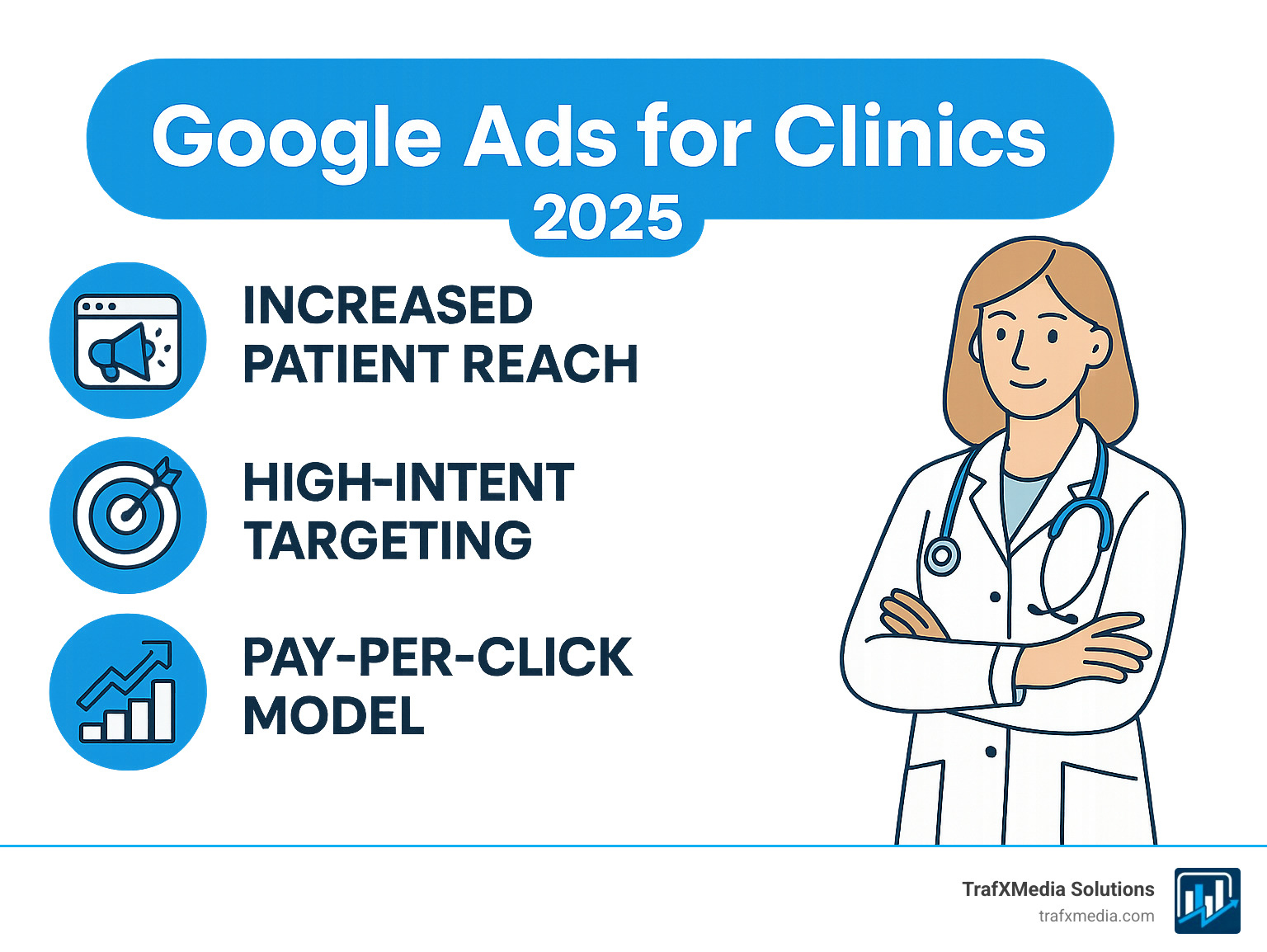
Google ads for clinics terminology:
The Power of Reaching Patients in Real-Time
One of the most compelling reasons to use Google ads for clinics is the ability to reach patients precisely when they are searching for care. This is especially powerful for urgent needs. When a patient types a query like “urgent care clinic open now,” they express a clear, immediate need. Your ads can capture this demand in real-time.
This real-time engagement is invaluable for local patient acquisition. By targeting specific geographic areas, we ensure your ads are seen by people within your service radius. This complements organic search efforts (SEO) by providing instant visibility at the top of search results. Using PPC ads alongside a strong organic presence makes your practice far more prominent, significantly boosting your chances of attracting new patients.
Measurable Benefits for Healthcare Practices
The benefits of utilizing Google ads for clinics extend far beyond visibility, contributing directly to your clinic’s growth:
- Increased Bookings and Patient Volume: By reaching high-intent patients, Google Ads can lead to a significant increase in appointment bookings and overall patient volume.
- Improved Brand Awareness: Repeatedly seeing your clinic’s name in search results builds brand recognition and trust, which is paramount in the healthcare sector.
- Competitive Advantage: In a crowded market, paid ads ensure you’re visible when it matters most, giving your clinic a distinct edge.
- Cost-Effective Advertising: The PPC model makes your advertising spend highly efficient. With controllable budgets and close performance monitoring, every part of your ad spend is accountable.
Understanding the Types of Google Ads for Healthcare
When it comes to Google ads for clinics, you have several ad formats at your disposal, each with unique strengths. Think of them as different tools in your medical kit, working together in your patient acquisition strategy. A comprehensive approach often involves using Search Ads for immediate needs, Display and Video Ads for building community awareness and trust, and Local Service Ads for dominating “near me” searches.
Search Ads: Capturing Active Patient Searches
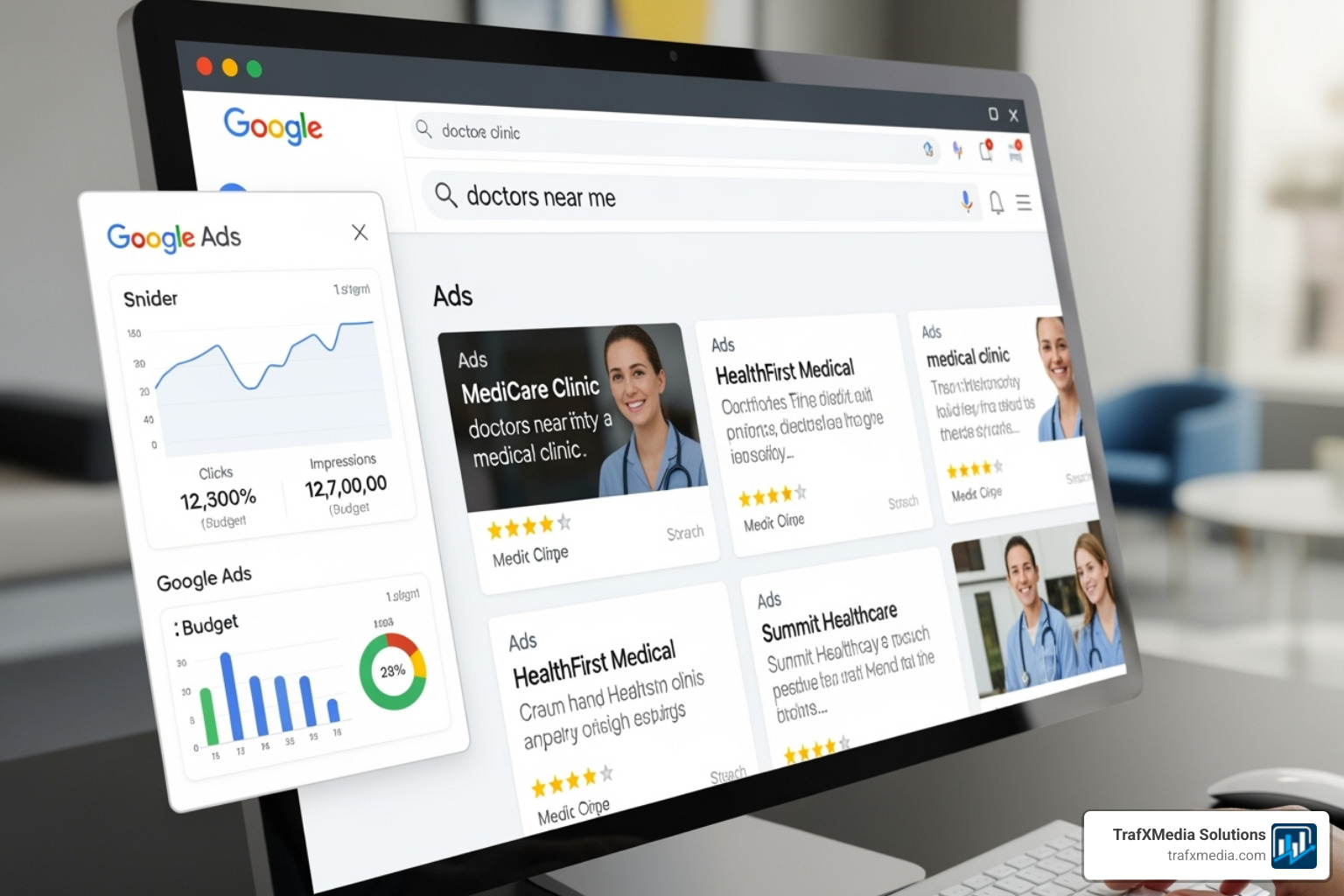
Search Ads are the workhorses of Google ads for clinics. These text-based ads appear at the top of search results precisely when someone is looking for your services. Through strategic keyword targeting, we ensure your ad appears for the exact terms your potential patients are using. A well-crafted Search Ad includes a compelling call-to-action and relevant details, leading to high conversion potential because it connects with users who are actively seeking solutions.
Your ad’s position isn’t just about the highest bid. It’s determined by Ad Rank, a score that Google calculates for every ad in an auction. Ad Rank is a combination of your bid amount and your Quality Score. Quality Score itself is comprised of three key factors: the expected click-through rate (CTR) of your ad, its relevance to the search query, and the quality of the user’s experience on your landing page. This system rewards clinics that provide the most relevant and helpful experience to searchers. With the PPC (Pay-Per-Click) model, you only pay when someone clicks, making every dollar of your ad spend accountable and efficient.
Display & Video Ads: Building Brand Awareness
While Search Ads capture existing demand, Display and Video Ads help create it. These visual advertising formats appear across Google’s network of millions of websites, apps, and on YouTube, offering a broader reach. They are perfect for patient education, showcasing success stories, introducing your team, or announcing a new service. For video, formats like skippable in-stream ads or shorter bumper ads can tell a compelling story about your clinic’s compassionate approach or advanced technology. A key feature is retargeting website visitors; if someone visits your site but doesn’t book, Display Ads can gently remind them of your clinic. (Note: Google’s strict policies restrict remarketing for sensitive health categories to protect patient privacy.) These formats excel at building trust and brand familiarity, which can be a deciding factor when a patient later needs care.
Local Service Ads: Dominating “Near Me” Searches
For clinics serving local communities, Local Service Ads (LSAs) are a game-changer. They appear at the very top of search results for local queries and operate on a trust-based advertising model. To participate, your clinic must undergo a screening process, which can include background and license checks. Upon successful completion, your ad can feature the coveted Google Guaranteed badge. This badge tells patients that Google has vetted and stands behind your business, which instantly builds credibility and sets you apart from competitors. The lead generation process is streamlined, allowing patients to call or message you directly from the ad. Crucially, LSAs use a pay-per-lead model, meaning you only pay for qualified inquiries from patients in your service area, not just for clicks. This makes them ideal for local clinics wanting to dominate “near me” searches and establish themselves as the go-to choice in their community.
Mastering Google Ads for Clinics: A Step-by-Step Campaign Setup Guide
Setting up an effective Google ads for clinics campaign requires careful planning and execution. We’ll walk you through the essential steps to ensure your ads are optimized for success.

The following sections will guide you through each critical component of campaign setup, from establishing your account structure to optimizing your landing pages for maximum conversion potential.
1. Foundational Account and Campaign Structure
To begin with Google ads for clinics, you’ll first sign up for a Google Ads account. During setup, we recommend switching to ‘Expert Mode.’ This provides the granular control needed to fine-tune your campaigns for optimal performance and ensure your budget is used effectively.
A strong campaign structure is the blueprint for success. We organize your account into Campaigns, which are broad categories based on your clinic’s services (e.g., “Orthopedic Surgery”) or marketing goals (e.g., “New Patient Acquisition”). This helps direct your ad spend with precision.
Within each Campaign, we create Ad Groups. Each Ad Group contains a set of closely related keywords and corresponding ads. For an “Orthopedic Surgery” campaign, you might have Ad Groups for “Knee Replacement” and “Hip Replacement.” This thematic keyword grouping ensures that when someone searches for a specific service, they see a highly relevant ad. This relevance improves the patient experience and boosts ad performance.
2. Essential Campaign Settings for Google Ads for Clinics
Fine-tuning your campaign settings is like steering your Google ads for clinics campaign. These settings determine where, when, and to whom your ads are shown, directly impacting your budget’s efficiency and the quality of leads you receive.
- Networks: We recommend starting with the Google Search Network, where people are actively searching for your services. We typically deactivate the Display Network and Search Partners initially to focus your budget on the highest-intent users. This prevents your text ads from appearing on less relevant websites or search engines, giving you maximum control.
- Location Targeting (Geotargeting): This is crucial for clinics. We target specific cities, counties, or a radius around your practice to ensure your ads only reach potential patients in your service area. Advanced options allow for targeting specific zip codes or even excluding areas within your main target zone, preventing wasted ad spend on audiences who are too far away to visit.
- Language Settings: We set the language to match that of your patient base, ensuring your message connects with the right audience and feels native to them.
- Ad Scheduling: You can control when your ads run. This practice, known as dayparting, allows you to show ads during business hours when staff are available to respond to inquiries, maximizing the value of each lead. You can even set bid adjustments to bid more aggressively during your busiest intake hours.
- Budget Determination: We help you set a daily budget that aligns with your growth goals. We can start conservatively and scale up as we analyze performance, ensuring your advertising budget works efficiently to bring qualified patients to your practice.
- Bidding Strategy: Choosing the right bidding strategy is vital. While new campaigns can benefit from Manual CPC or Improved CPC (eCPC) to gain initial control and data, the ultimate goal is often to move to an automated strategy. Once enough conversion data is collected, strategies like Maximize Conversions (which aims to get the most conversions for your budget) or Target CPA (Cost-Per-Acquisition) (which aims to get conversions at a specific average cost) can use Google’s machine learning to optimize bids in real-time, improving efficiency and saving valuable time.
3. Strategic Keyword Research and Selection
Effective keyword research for Google ads for clinics is about understanding your patients’ needs and search behavior. We focus on patient search intent, distinguishing between informational searches (e.g., “symptoms of diabetes”) and transactional or commercial searches (e.g., “diabetes specialist near me”). Our primary focus is on keywords that indicate a user is ready to book an appointment.
Long-tail keywords—longer, more specific phrases like “emergency dentist open Sunday San Francisco”—are invaluable. They often have less competition, lower costs, and attract highly qualified patients who know exactly what they need.
We use keyword match types to control when your ads appear, balancing reach with relevance.
- Exact Match
[keyword]: Provides the most control, showing your ad only for searches that have the same meaning as your keyword. - Phrase Match
"keyword": Offers a balance of control and reach, showing ads on searches that include the meaning of your keyword. - Broad Match
keyword: Provides the widest reach but requires careful monitoring and a robust negative keyword list to avoid irrelevant traffic.
Negative keywords are just as important as the ones you target. By creating and continuously updating a negative keyword list with terms like “free,” “jobs,” or “training,” we prevent your ads from showing for irrelevant searches. This is one of the most effective ways to reduce wasted ad spend and improve your campaign’s ROI.
To build this comprehensive keyword list, we use tools like Google’s Keyword Planner to assess search volume and cost estimates. We also leverage competitor analysis platforms like SEMrush or Ahrefs to uncover the high-performing keywords that are already working for other clinics in your market, connecting you with patients actively seeking care.
4. Crafting Compelling, Compliant Ad Copy
Your ad copy is your clinic’s digital first impression. For Google ads for clinics, it must be inviting, clear, and carefully compliant with healthcare advertising rules.
We use patient-centric language, focusing on the benefits and solutions you provide in a warm, empathetic tone. Instead of a clinical, feature-based statement like “We offer advanced diagnostic imaging,” we craft a patient-focused message like “Get Clear Answers Fast. Advanced Imaging for Accurate Diagnosis.” Every ad includes a clear Call-to-Action (CTA), such as “Book Your Appointment Online” or “Call Now for a Consultation,” to guide patients on their next step.
Highlighting your unique value is essential. We emphasize what makes your clinic the best choice, whether it’s specialized services, state-of-the-art technology, compassionate care, or convenient hours.
Modern ad creation revolves around Responsive Search Ads (RSAs). With RSAs, we provide Google with multiple headlines (up to 15) and descriptions (up to 4). Google’s AI then tests different combinations to learn which ones perform best for different search queries and users. This allows for continuous optimization and ensures your ad message is always as relevant as possible.
We improve your ads with ad extensions, which provide extra information and make your ad stand out, increasing its size and click-through rate:
- Sitelink Extensions: Link to specific pages like “Our Services,” “Meet Our Doctors,” or “Patient Testimonials.”
- Callout Extensions: Highlight key features like “Board-Certified Specialists,” “Same-Day Appointments,” or “Accepting New Patients.”
- Call Extensions: Add a clickable phone number for mobile users, making it easy for patients to call you directly.
- Location Extensions: Display your clinic’s address, hours, and a map marker, which is essential for attracting local patients.
- Structured Snippet Extensions: List specific services or treatments in an organized format.
- Image Extensions: Add relevant, compelling visuals to your search ads, helping them capture attention on the results page.
These extensions make your ads more informative and effective, increasing the likelihood of turning a click into a new patient.
5. Optimizing Your Clinic’s Landing Pages
Your landing page is where a click becomes a patient. For Google ads for clinics, this page must be a seamless continuation of the ad, instantly meeting the visitor’s expectations.
Ad-to-page relevancy is critical. If your ad promises “emergency dental care,” the landing page must be exclusively about that service, not your general homepage. This alignment improves user experience and is rewarded by Google with a higher Quality Score, which can lower your ad costs and improve ad performance.
Key elements for a successful landing page include:
- Fast Load Times: A page that takes more than three seconds to load loses nearly half its visitors. We use tools like Google’s PageSpeed Insights tool to diagnose and fix issues that slow your pages down.
- Mobile Optimization: With most healthcare searches happening on smartphones, your landing page must function perfectly on any device. This means large, thumb-friendly buttons, readable text without zooming, and simple navigation.
- Clear Contact Information: Your phone number should be prominent and clickable (“click-to-call”). Contact forms should be simple, asking only for essential information to reduce friction.
- Prominent Trust Signals: Build immediate credibility by displaying patient testimonials, doctor credentials and photos, logos of accepted insurance providers, and badges from professional associations (e.g., AMA, ADA). These signals reassure visitors they’ve found a reputable provider.
- Conversion-Focused Design: The page should have a clear, benefit-oriented headline, trust signals, and obvious calls-to-action that guide visitors toward booking an appointment.
To maximize results, we advocate for A/B testing key landing page elements. By creating two versions of a page (e.g., one with a different headline or call-to-action button) and showing them to different visitors, we can scientifically determine what works best. This iterative process of testing and refining can significantly increase your conversion rate over time, ensuring you get the most value from every ad click.
Navigating Compliance: HIPAA and Google’s Healthcare Policies
Adhering to Google’s Healthcare Advertising Rules
Google’s healthcare advertising policies are strictly enforced. A key rule is the Personalized Advertising policy, which prohibits targeting users based on sensitive health conditions. This means we cannot create audiences based on conditions like diabetes or depression.
Google’s Healthcare and Medicines policy also outlines prohibited content, such as unapproved substances or speculative treatments. Advertising prescription drug terms is restricted and often requires special certification to prove you are a legitimate provider.
Ensuring Your Campaigns are HIPAA Compliant
HIPAA exists to protect Patient Health Information (PHI), and this extends to advertising. Our ad copy must avoid language that could reveal or imply a person’s medical condition. Avoiding remarketing for sensitive conditions is crucial for privacy. Furthermore, any system that collects patient information, like a landing page form, requires secure data handling and must be HIPAA compliant, often involving Business Associate Agreements (BAA).
The Do’s and Don’ts of Advertising for Clinics
Following clear guidelines makes compliance easier. Focusing on what you should do naturally leads to better, more effective advertising that helps people find the care they need.
| Do’s | Don’ts |
|---|---|
| Focus on services and solutions. | Make misleading or unrealistic claims about treatments. |
| Use compliant, general, and empathetic language. | Use sensitive or assumptive language (e.g., “Are you depressed?”). |
| Target locally and by service. | Target based on inferred health conditions or personal attributes. |
| Highlight your clinic’s unique value. | Include Personal Health Information (PHI) in ads or tracking. |
| Use clear, action-oriented CTAs. | Use before-and-after imagery without explicit consent and clear context. |
| Ensure landing pages are relevant and secure. | Promote unapproved substances or speculative treatments. |
| Obtain necessary certifications for restricted services. | Engage in remarketing for sensitive health categories. |
| Regularly review Google’s policy updates. | Ignore Google’s policy warnings or ad disapprovals. |
Measuring Success and Optimizing Performance
Launching your Google ads for clinics campaign is just the beginning. Continuous monitoring, analysis, and optimization are essential to maximize your investment and grow your patient numbers. We believe in a data-driven approach to campaign management, where every decision is backed by performance metrics.
Key Metrics Every Clinic Should Monitor
We track key performance indicators (KPIs) to understand how your ads are performing and make informed decisions:
- Click-Through Rate (CTR): The percentage of people who see your ad and click it. A high CTR indicates your ad copy is compelling and relevant to your keywords.
- Cost-Per-Click (CPC): The average amount you pay for each click. We aim for an efficient CPC based on your specialty and market.
- Conversion Rate: The percentage of clicks that result in a desired action, like a phone call or form submission. This is the ultimate measure of your ad and landing page effectiveness.
- Cost-Per-Acquisition (CPA): The average cost to acquire one new lead. Our goal is to keep this figure efficient while attracting high-quality potential patients.
- Impression Share: This metric tells you what percentage of the time your ads were shown out of the total number of times they could have been shown. A low impression share might indicate your budget is too low or your Ad Rank needs improvement. It’s a key indicator of your visibility and market competitiveness.
- Ad Position: Understanding where your ads typically appear on the page provides insight into visibility and how you stack up against competitors.
How to Track Your Campaign’s ROI
True return on investment (ROI) tracking connects ad spend to patient acquisition. Setting up conversion tracking is fundamental. We configure your account to track valuable actions like phone calls from ads, calls from your website, and form submissions. To understand the full impact, we also consider the Patient Lifetime Value (LTV). A high LTV can justify a greater initial investment to acquire a new patient, as their value to the clinic will be realized over many years.
The Ongoing Optimization Routine
Steering clear of common pitfalls is key to success. A “set it and forget it” mentality is one of the biggest mistakes. Google Ads campaigns require continuous management. A typical optimization routine includes:
- Reviewing the Search Terms Report: This weekly task involves analyzing what people actually typed to trigger your ads. We add irrelevant terms to the negative keyword list to stop wasting money and find new, high-performing keyword ideas.
- Analyzing Ad Performance: We regularly check the performance of Responsive Search Ads, pausing underperforming assets (headlines/descriptions) and testing new variations to constantly improve CTR and conversion rates.
- Adjusting Bids and Budgets: Based on performance, we reallocate budget to top-performing campaigns and adjust bids on keywords to maximize ROI.
- Monitoring Auction Insights: This report shows you who your competitors are and how you stack up in terms of visibility, helping to inform strategic decisions.
Frequently Asked Questions about Google Ads for Clinics
It’s normal to have questions when considering Google ads for clinics. Here are answers to some of the most common queries.
How should a clinic approach budgeting for Google Ads?
There’s no one-size-fits-all budget. The right amount depends on your specialty, location, and competition. A good approach is to establish a starting budget that allows for enough data collection to see what works—typically for at least 30-60 days. Ad costs can vary dramatically based on your geographic location (e.g., San Francisco will be more expensive than a smaller town) and the competitiveness of your services (e.g., keywords for cosmetic surgery are often more expensive than for general check-ups).
The key is flexibility. We scale your spending based on performance. We start with a thoughtful budget, monitor the results, and can increase the investment as we see a positive return. The focus should always be on the return on investment (ROI), not just the total spend. Acquiring a new patient with a high lifetime value is a smart investment.
Are Google Ads better than SEO for clinics?
This isn’t an either/or question. Google ads for clinics and SEO (Search Engine Optimization) are two powerful strategies that work best together in a synergistic relationship.
Google Ads provide immediate visibility, placing you at the top of search results instantly. This is ideal for capturing patients seeking care right now. SEO is a long-term strategy that builds your organic (non-paid) rankings over time, creating a sustainable source of traffic and authority.
They complement each other perfectly. The keyword data from a successful Google Ads campaign can provide invaluable insights to inform your SEO strategy, showing you which terms convert best. Conversely, a strong organic presence and a high-quality website (a result of good SEO) improve the landing page experience, which boosts your Quality Score and can lower your ad costs. Using both creates a dominant online presence that captures both immediate demand and builds long-term, sustainable growth.
How long does it take to see results from Google Ads?
You can see initial results, like clicks and impressions, almost immediately after your campaign launches. However, seeing meaningful, optimized results and a consistent return on investment takes time. The first month is typically a data-gathering and learning phase. We analyze initial performance, refine keyword lists, and test ad copy. You can expect to see more stable and optimized performance within 2-3 months, as we accumulate enough data to make strategic adjustments and allow Google’s machine learning algorithms to fully optimize your bidding strategy. Patience during this initial period is key to achieving long-term success.
When should a clinic partner with a marketing expert?
While you can manage basic campaigns yourself, the complexity of Google Ads and strict healthcare advertising rules make professional partnership valuable. Clinic owners are busy with patient care and often lack the time for the constant monitoring that effective ad management requires.
A marketing expert brings specialized expertise to avoid costly mistakes and accelerate growth. They have a deep understanding of bidding strategies, keyword nuances, conversion rate optimization, and advanced platform features. Most importantly, an expert can steer complex compliance issues like HIPAA and Google’s ever-changing policies, protecting your clinic from ad disapprovals or account suspension. As you grow, an expert can scale your campaigns strategically, ensuring your advertising keeps pace with your success.
Partner with Experts to Accelerate Your Clinic’s Growth
Running a successful clinic is demanding. Mastering the intricacies of digital marketing on top of that is a significant challenge. While Google ads for clinics offer tremendous growth potential, effective campaigns require specialized knowledge, constant attention, and a deep understanding of healthcare compliance.
At TrafXMedia Solutions, we bridge this gap for healthcare providers in the San Francisco area. Your expertise is patient care; ours is managing complex Google Ads campaigns. Our Google-Certified specialists craft data-driven strategies custom to your practice, your patients, and your growth goals.
Our intimate knowledge of the San Francisco healthcare landscape allows us to create campaigns that resonate with Bay Area patients. We handle the complex compliance considerations, from HIPAA to Google’s evolving policies, so you can focus on what you do best.
We manage every aspect of your campaigns, from keyword research to conversion tracking, ensuring your investment translates into new patient appointments. Our continuous optimization process means your campaigns improve over time. Let us help you connect with patients at the moment they need you most.
Ready to transform your clinic’s online presence and see real growth? Get expert Google Ads management in San Francisco and find how the right digital marketing partnership can turn clicks into patients.