

The Small Business Owner’s Playbook: Setting Up Social Media for Success
Why Setting Up Social Media Is Critical for Small Business Success
Setting up social media for small business is essential for reaching customers where they spend hours daily. With most small businesses using social media in their marketing, the question isn’t if you should be on social platforms—it’s how to do it right.
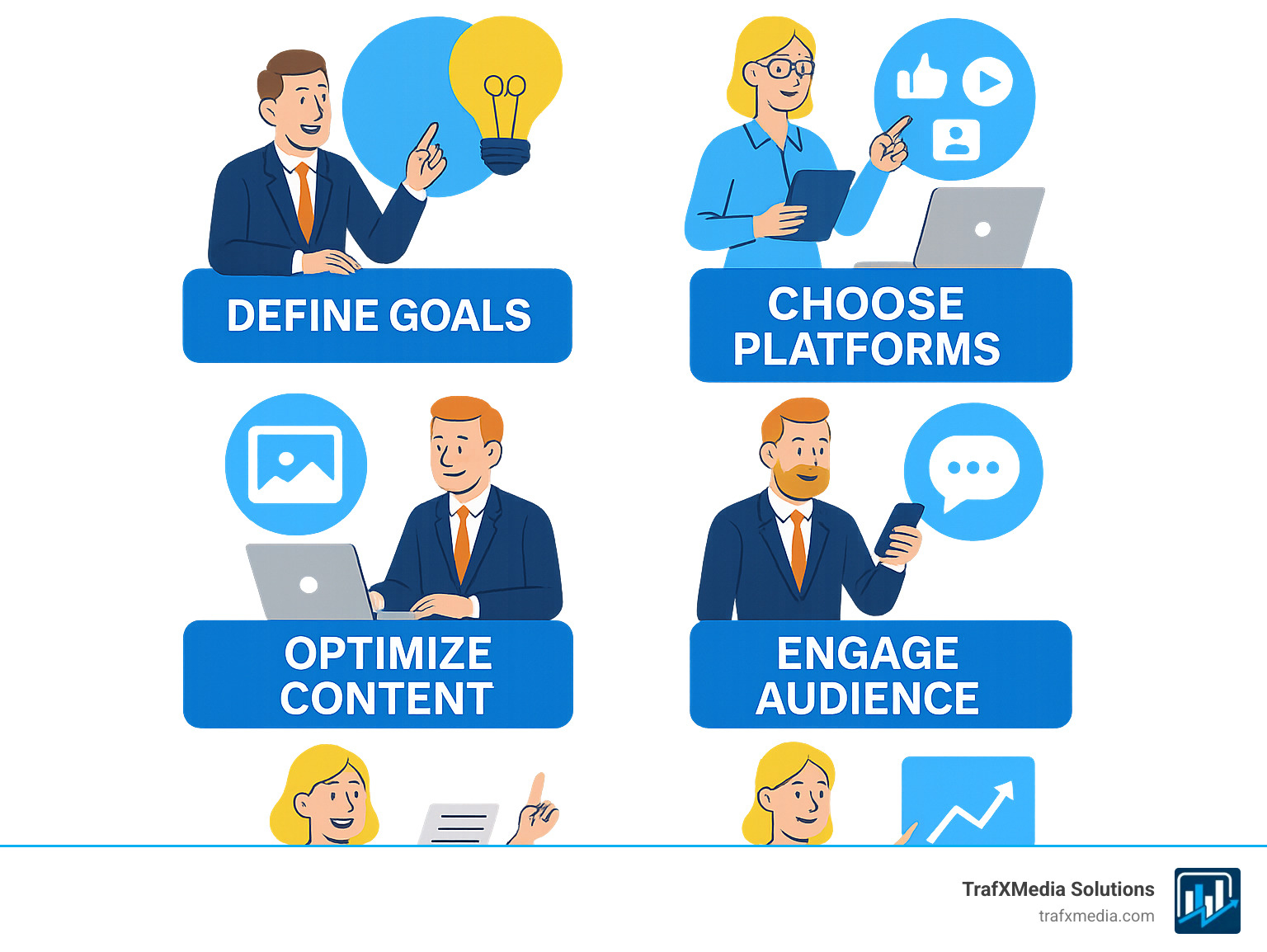
Quick Setup Guide for Small Business Social Media:
- Define clear goals like brand awareness or lead generation
- Choose 1-3 platforms where your audience is most active
- Optimize your profiles with consistent branding
- Create a content strategy following the 80/20 rule
- Engage authentically with your audience
- Track performance with analytics to refine your approach
The benefits are compelling. Over 55% of consumers find new brands through social media, and 67% have used these platforms to make purchases.
However, social media can feel overwhelming. Between choosing platforms, creating content, and managing engagement, it’s easy to get lost. The good news? A strategic approach makes all the difference.
I’m Richard Taylor, an SEO strategist and business consultant. I’ve helped globally recognized brands and startups steer the digital landscape, focusing on setting up social media for small business success. My experience ensures businesses build a social media presence that drives measurable results.
Why Social Media is a Game-Changer for Small Businesses
Social media puts your business right where your customers are spending their time—on their phones. Setting up social media for small business is about tapping into how people now find, research, and connect with brands. It acts as your digital storefront, customer service desk, and marketing department all in one.
With billions of active users worldwide, social platforms are the modern marketplace. Over 55% of consumers find new brands on social media, meaning your next customer is likely scrolling through their feed right now.
Key benefits include:
- Direct Customer Communication: Social media breaks down barriers, allowing for real-time conversations. Imagine a potential customer asking about your store hours in a comment. A quick, friendly reply not only helps them but also shows other followers that you’re responsive and helpful. This transparency builds trust. Answering a customer’s question quickly can lead to a sale, as nearly 80% of consumers are more likely to buy after positive social interactions.
- Build Brand Personality: Are you witty and playful, or helpful and encouraging? Social media is where you can move beyond a corporate logo and showcase your team, your values, and your unique sense of humor. This creates a more personal, memorable relationship with customers that traditional advertising simply can’t replicate. It’s how you turn customers into a community.
- Drive Website Traffic, Leads, and Sales: Every post, Story, or Reel is an opportunity to guide users to your website, a specific product page, or a lead capture form. With features like Instagram’s “link in bio,” shoppable tags on posts, and direct links in Stories, you can create a seamless path from findy to purchase. With 67% of users making purchases directly on these platforms, the impact on your bottom line is direct and significant.
- Gain Customer Insights: Platform analytics are a goldmine of free market research. They reveal customer demographics, which posts resonate most, what time of day your audience is online, and even the questions and challenges they’re discussing in comments. This invaluable data can inform everything from your next product launch and service offerings to your marketing messaging.
- Competitive Advantage: A strategic social media presence helps you stand out. By building genuine connections and providing value, you can create a loyal community that chooses you over competitors. Furthermore, social media is a powerful tool for competitive analysis. You can observe your competitors’ strategies, see what’s working for them, identify customer complaints, and find gaps in the market that your business can fill.
Social media allows small businesses to reach target audiences in a cost-effective way, targeting ideal customers with a precision that was once only available to large corporations. Whether you’re a local bakery or a global consulting firm, these platforms level the playing field and give every small business a chance to shine.
A Step-by-Step Guide to Setting Up Social Media for Small Business
Setting up social media for small business doesn’t have to be daunting. A clear roadmap helps you build an online presence that supports your business goals. This isn’t about posting randomly; it’s about strategic planning for a foundation that supports long-term growth through consistency.

Step 1: Define Your Goals and Key Performance Indicators (KPIs)
Before you post anything, define what success looks like. Without clear goals, your efforts will be aimless and impossible to measure. Set SMART goals: Specific, Measurable, Achievable, Relevant, and Time-bound.
Common goals include:
- Brand Awareness: Increase brand recognition. (e.g., Increase Instagram post reach by 20% and followers by 10% in Q1.)
- Lead Generation: Drive potential customers to your sales funnel. (e.g., Generate 50 new email subscribers from a LinkedIn lead magnet campaign this month.)
- Community Engagement: Build an interactive and loyal audience. (e.g., Increase the average number of comments per post by 25% over the next three months.)
- Website Traffic: Direct users to your website for more information or sales. (e.g., Increase social media referral traffic to our blog by 30% this quarter.)
- Conversion: Drive direct sales or sign-ups. (e.g., Achieve 10 direct sales per week from Facebook Shop.)
Track Key Performance Indicators (KPIs) to measure these goals. It’s vital to focus on metrics that matter for business decisions, not just ‘vanity metrics’ like follower count, which can be misleading. Important KPIs include:
- Reach: The number of unique users who saw your content.
- Engagement Rate: The percentage of your audience that interacted (liked, commented, shared, saved) with your content. This is a key indicator of content quality.
- Click-Through Rate (CTR): The percentage of people who saw your post and clicked on a link in it.
- Conversion Rate: The percentage of users who take a desired action (like making a purchase or filling out a form) after clicking a link.
Step 2: Identify and Understand Your Target Audience
Knowing who you’re trying to reach is the most critical step. You can’t create compelling content if you don’t know who you’re talking to. The best way to do this is by creating customer personas, which are detailed representations of your ideal customers.
To build these personas, you need data. Find it by:
- Analyzing your current customers: Look at your sales data and client list.
- Using platform analytics: Facebook Audience Insights and other native tools provide rich demographic data about your followers.
- Conducting surveys: Use tools like SurveyMonkey or Google Forms to ask your audience directly about their needs and preferences.
- Analyzing competitors: Look at who is following and engaging with your competitors.
Your persona should include:
- Demographics: Age, gender, location, income, occupation.
- Psychographics: Hobbies, values, interests, lifestyle.
- Pain points: What challenges are they facing that your product or service can solve?
- Goals: What are they trying to achieve?
- Social Media Habits: Which platforms do they use? What kind of content do they engage with? Who do they follow?
This deep understanding helps you tailor your content, tone of voice, and platform choice to resonate powerfully with the right people.

For a broader understanding of platform-specific audience demographics, consider reviewing research on social media use here.
Step 3: Choose the Right Social Media Platforms for Your Business
With goals and audience defined, select the platforms that will yield the best results. The biggest mistake small businesses make is trying to be everywhere at once. This stretches resources thin and leads to burnout. It’s far better to excel on one or two platforms than to be mediocre on five.
Focus on 1-3 key platforms where your audience is most active and engaged. Consider these factors:
- Audience Alignment: Is your target customer actively using this platform?
- Business Type: Is your business highly visual (B2C e-commerce) or more information-driven (B2B services)?
- Content Format Suitability: Can you realistically create the type of content that succeeds on the platform (e.g., high-quality video for TikTok, professional articles for LinkedIn)?
- Resource Allocation: Do you have the time and skills to manage the platform effectively?
Here’s a quick comparison of popular platforms:
| Platform | Primary Audience Demographics | Content Format Focus | Best For |
|---|---|---|---|
| Broad (all ages, particularly 30+), local communities | Text, images, video, Groups, live streaming, ads | Community building, local engagement, targeted ads | |
| Younger demographics (18-34), visual-centric | High-quality images, short-form video (Reels), Stories | Visual brands, e-commerce, influencer marketing, lifestyle content | |
| Professionals, B2B audience (25-54) | Articles, professional updates, industry insights, text | B2B networking, thought leadership, recruitment, lead generation | |
| Predominantly female (25-54), interested in inspiration/ideas | High-quality vertical images, infographics, tutorials | Visually-driven products, driving website traffic, e-commerce | |
| TikTok | Gen Z and younger millennials (13-29), highly creative | Short-form video, trends, challenges, humor | Creative brands, viral content, entertainment, reaching younger audiences |
| X (formerly Twitter) | News, real-time updates, conversational (18-49) | Short text, links, images, GIFs, quick interactions | Breaking news, customer service, real-time engagement, public relations |
Step 4: Key Steps for Setting Up Social Media for Small Business Profiles
Once you’ve chosen your platforms, optimize your profiles for professionalism and findy. Consistency is key across all networks to build brand recognition.
- Use Your Business Name: Keep your profile name and username (handle) as consistent as possible across platforms. If you’re “San Francisco Bakery,” try for
@SFBakeryeverywhere. - Professional Profile Picture: Use your company logo. Ensure it’s a high-resolution file that is clear and recognizable even as a small circle.
- Compelling Bio: Your bio is your elevator pitch. In 150 characters or less, state what you do, who you serve, and your unique value proposition. Include a call-to-action (CTA). For example, instead of “Bakery in SF,” try “Artisanal sourdough & pastries in San Francisco. 🥖 Daily fresh bakes. Order online for pickup! 👇”
- Contact Information: Fill out every available field: address, phone number, and email. This makes it easy for customers to do business with you.
- Website Link: Always include a link to your website in your bio. Use a link-in-bio tool if you want to direct traffic to multiple pages.
- Cover Photo Optimization: Use the cover photo on platforms like Facebook, LinkedIn, and X to showcase your products, announce a promotion, feature your team, or reinforce your brand’s value proposition.
- Enable Two-Factor Authentication (2FA): This is a non-negotiable security step. Protect your brand’s accounts from being hacked by enabling 2FA on all platforms.
Don’t forget to claim and fully optimize your Google Business Profile, which functions as a social platform for local search.
Step 5: Content Strategy for Setting Up Social Media for Small Business
An effective content strategy is the engine of your social media presence. It’s about posting strategically, not just frequently. A great starting point is the 80/20 rule:
- 80% Value-Driven Content: This content should educate, entertain, or inspire your audience. It builds trust, authority, and community. Examples include how-to guides, behind-the-scenes looks, sharing user-generated content (UGC), and telling relatable stories.
- 20% Promotional Content: This content directly promotes your products, services, or offers. Because you’ve built trust with the other 80%, this content will be much more effective.
Develop 3-5 content pillars (overarching themes) that align with your brand and audience’s interests. For our San Francisco bakery, pillars could be: 1. Product Showcase (mouth-watering photos of daily specials), 2. Community Spotlight (featuring a local coffee partner), 3. Educational Tips (how to store sourdough), 4. Behind the Scenes (meet the baker). This framework prevents you from running out of ideas.
Create a content calendar to plan posts in advance. This ensures consistency and reduces daily stress. Quality and consistency trump quantity. Posting three high-quality, engaging posts per week is far more effective than posting ten low-effort ones.
Step 6: Master Audience Engagement and Community Building
Engagement is where relationships are built. Social media is a two-way street, and building a community requires active participation, not just broadcasting.
- Respond to Comments and Messages Promptly: Aim to respond to all legitimate comments and DMs within a few hours. This shows you value your audience and are listening.
- Encourage Conversations: Don’t just post and ghost. Ask questions in your captions, run polls in your Stories, and host Q&As to invite dialogue and boost engagement.
- Handle Negative Feedback Gracefully: Not all feedback will be positive. When faced with a negative comment, respond publicly with empathy. Acknowledge their concern and offer to resolve the issue offline via DM or email. This shows other customers you take feedback seriously.
- Feature Customer Content: Reshare content from customers who tag you (with their permission). This is powerful social proof and makes your customers feel like valued members of your community.
- Engage Proactively: Don’t just wait for engagement to come to you. Dedicate time to follow relevant accounts, comment thoughtfully on their posts, and participate in industry conversations. Use social listening to find these opportunities.
By fostering genuine interactions, you transform followers into loyal customers and brand advocates.
Step 7: Measure, Analyze, and Refine Your Approach
This final step is crucial for ensuring your efforts drive real business results. Most platforms offer robust native analytics tools (e.g., Meta Business Suite, TikTok Analytics) that provide data on:
- Engagement metrics: Likes, comments, shares, saves.
- Follower growth: How quickly your audience is expanding.
- Reach and impressions: How many people saw your content.
- Website referral traffic: Clicks to your website from social media (track this in Google Analytics).
- Audience demographics: Who is engaging with your content (age, gender, location).
Track your KPIs weekly or bi-weekly. Conduct a more strategic review every month or quarter. Ask yourself: What worked? What didn’t? Why? Use this data to refine your strategy. Use A/B testing on captions, images, or CTAs to see what performs better. Use analytics to optimize post times based on when your specific audience is most active.
This continuous cycle of measuring, analyzing, and refining is what turns your social media from a daily chore into a powerful, predictable growth engine.
Essential Tools and Resources to Streamline Your Social Media
Managing social media effectively takes time, but the right tools can be a massive force multiplier. Think of them as your digital assistants, helping you streamline your workflow, improve content quality, and gain deeper insights.

- Social Media Management Tools: Platforms like Buffer, Hootsuite, or Later act as a central command center. They let you schedule posts across multiple platforms in advance, monitor brand mentions, and track analytics from one dashboard. This saves countless hours and ensures a consistent posting schedule. Later is particularly strong for visually-focused platforms like Instagram and Pinterest.
- Graphic Design Platforms: Stunning visuals are non-negotiable. Canva and Adobe Express are game-changers for non-designers. They offer thousands of professional templates, stock photos, and easy-to-use editors to create beautiful images, infographics, and short videos.
- Video Editing Apps: With short-form video dominating platforms like Instagram and TikTok, user-friendly mobile apps are essential. CapCut and InShot let you quickly edit clips, add text overlays, include trending audio, and create engaging videos directly from your phone.
- Analytics and Reporting Software: While native platform insights are a great start, you should also ensure your Google Analytics is set up correctly to track how much website traffic and how many conversions are coming from each social channel. This helps you prove the ROI of your efforts.
- Hashtag Research Tools: To get your content seen by new audiences, you need to use relevant hashtags. Tools like RiteTag and Hashtagify help you find a mix of popular and niche hashtags to boost your reach and connect with potential customers actively searching for your products or services.
- Link-in-Bio Tools: Platforms like Instagram and TikTok only allow one clickable link in your bio. A tool like Linktree, Lnk.Bio, or Later’s Linkin.bio creates a simple, custom landing page where you can house multiple important links to your website, blog posts, product pages, and special offers, maximizing the value of that single link.
These tools save time and empower your business to shine online by streamlining workflows, improving content quality, and providing invaluable insights.
Common Mistakes to Avoid When Managing Your Social Media
After setting up social media for small business success, it’s crucial to sidestep common pitfalls that can undermine your hard work. Knowing what not to do is as important as knowing what to do.
- Inconsistent Posting: Sporadic posts make your brand seem unreliable and decrease engagement as algorithms may show your content less often. A steady, consistent presence keeps your audience engaged. What to do instead: Create a simple content calendar and use a scheduling tool to plan posts a week or two in advance. Consistency beats frequency.
- Ignoring Comments and Messages: Social media is a two-way conversation. Failing to respond to comments and DMs makes customers feel unheard and can damage your brand’s reputation. What to do instead: Block out 15-20 minutes each day specifically for ‘community management’—replying to comments, answering DMs, and engaging with posts you’re tagged in.
- Being Overly Promotional: If every post is a sales pitch (“Buy Now!”), you’ll alienate your audience. People use social media for connection and value, not constant ads. What to do instead: Follow the 80/20 rule. Focus 80% of your content on educating, entertaining, or inspiring your audience. This builds trust, making the 20% of promotional content more effective.
- Not Tailoring Content for Each Platform: Copying and pasting the same exact post everywhere ignores each platform’s unique culture, audience expectations, and technical formats. A formal article for LinkedIn won’t work as a TikTok video. What to do instead: Adopt a ‘create once, distribute many ways’ approach. A single idea can be repurposed into a LinkedIn article, an Instagram carousel with key takeaways, and a short video script for a Reel. Always adapt the format and caption.
- Spreading Yourself Too Thin: Trying to be active on every single platform is a recipe for burnout and mediocre results. A neglected, empty profile is worse than no profile at all. What to do instead: Start with one or two platforms where you know your audience spends their time. Master them first. It’s better to be a star on Instagram than a ghost on five different networks.
- Neglecting Analytics: Working without data is like driving blindfolded. Without checking your analytics, you won’t know what’s resonating with your audience, what’s driving traffic, or if your efforts are generating a return on investment. What to do instead: Schedule a monthly 30-minute check-in to review your KPIs. Identify your top-performing post and ask ‘why’ it worked. This simple habit will make your strategy smarter over time.
- Lacking a Clear Strategy: Simply “being on social media” isn’t a strategy. Without clear goals, audience knowledge, and a content plan, your efforts will be chaotic and ineffective. What to do instead: Before you start, write a one-page social media strategy document. It should answer: 1) What are our business goals? 2) Who is our target audience? 3) Which 1-3 platforms will we focus on? 4) What are our content pillars? This document is your compass.
Frequently Asked Questions About Small Business Social Media
Here are answers to some of the most common questions we hear from small business owners as they steer social media.
How often should a small business post on social media?
For small businesses, consistency over quantity is the golden rule. It’s far more important to post high-quality content steadily than to post multiple times a day just for the sake of it. The ideal frequency varies by platform. For Facebook or Instagram, 3-5 high-quality posts per week is a solid target. For a platform like X (formerly Twitter), which is more conversational, 1-3 times per day can be effective if you have the resources. LinkedIn often rewards depth over frequency, so 2-3 thoughtful posts per week is ideal.
Check your analytics to find when your specific audience is most active and schedule your posts during those times for better visibility. The most important thing is to find a sustainable rhythm you can stick to.
What type of content performs best on social media?
While performance varies by platform and industry, some content types consistently shine. The unifying theme is authenticity and value. Video content, especially short-form videos like Instagram Reels and TikToks, continues to dominate because it’s excellent for storytelling, showcasing personality, and demonstrating products. High-quality images and well-designed graphics also grab attention.
Other top performers include:
- Authentic stories: Behind-the-scenes content, your business’s origin story, or employee spotlights help create a human connection.
- User-generated content (UGC): Sharing posts from happy customers builds immense trust and acts as powerful social proof.
- Educational posts: How-to guides, quick tips, and myth-busting carousels position you as an expert in your field.
- Interactive content: Polls, quizzes, and “ask me anything” sessions are great for boosting audience involvement and learning about their preferences.
The best content always adds value by entertaining, educating, or inspiring your audience.
How can I manage social media with a limited amount of time?
As a busy small business owner, efficiency is key. You can manage social media effectively with these strategies:
- Content Batching: Dedicate a few hours one day per week or month to plan, create, and schedule all your content at once. This is far more efficient than trying to come up with a post every single day.
- Scheduling Tools: Use a platform like Buffer, Later, or Hootsuite to automate your posts in advance. This ensures a consistent presence even when you’re busy.
- Focus on 1-2 Key Platforms: Don’t spread yourself too thin. A strong, engaging presence on a few relevant platforms is better than a weak, inconsistent one on many.
- Repurpose Content: Save time by adapting one piece of content for multiple uses. A single blog post can be turned into several graphics, a short video script, a LinkedIn article, and an email newsletter section. This ‘content multiplication’ is a huge time-saver.
How much should a small business budget for social media?
There’s no single answer, but you can start effectively with a small budget. Your budget has two components: time (your own or an employee’s) and money. For monetary costs, consider tools (many have free or low-cost plans) and advertising. You don’t need a massive ad budget to start. Begin by ‘boosting’ your best-performing organic posts for as little as $5-$10 to expand their reach to a targeted audience. A good starting point is to allocate 5-10% of your overall marketing budget to social media ads and scale up as you see a positive return on investment.
How do I handle negative comments or trolls?
It’s bound to happen, so it’s best to have a plan. For legitimate customer complaints, use the Acknowledge, Apologize, Act framework. Publicly Acknowledge their issue (‘Thanks for bringing this to our attention’). Apologize for their negative experience (‘We’re sorry to hear you had trouble’). Then, Act by taking the conversation offline (‘Please DM us your order number so we can make this right’). This approach shows other customers that you are responsive and care. For trolls—users who are posting inflammatory comments just to provoke—the best policy is often to ignore them or use the platform’s tools to hide their comments or block the user. Never get into a public argument.
Conclusion: Turn Your Social Media Presence into a Growth Engine
Setting up social media for small business is a smart investment. By focusing on strategic planning, consistency, and audience engagement, you can build a powerful engine for growth.
Social media is a marathon, not a sprint. It requires patience and a willingness to adapt to the ever-changing digital landscape. Learning from your data will keep you ahead of the curve.
Feeling overwhelmed? You’re not alone. At TrafXMedia Solutions, we help local San Francisco businesses thrive online. We understand the unique needs of our community and are passionate about helping you succeed.
Ready to boost your social media and connect with customers? We can guide you in building a presence that brings real, measurable results.
Let’s build something amazing together. Explore our digital marketing services today!