Clicking with the Bay: How Online Ads Boost San Francisco Businesses
Why San Francisco Businesses Must Master Online Advertising
Online ads San Francisco give local companies a way to compete— and win— in one of the most tech-savvy cities on the planet.
- Market size: San Francisco is the second-most densely populated U.S. city and attracts millions of digital visitors each month.
- Buying power: 59 % of local business-media readers hold owner or partner roles, and 86 % influence purchasing decisions.
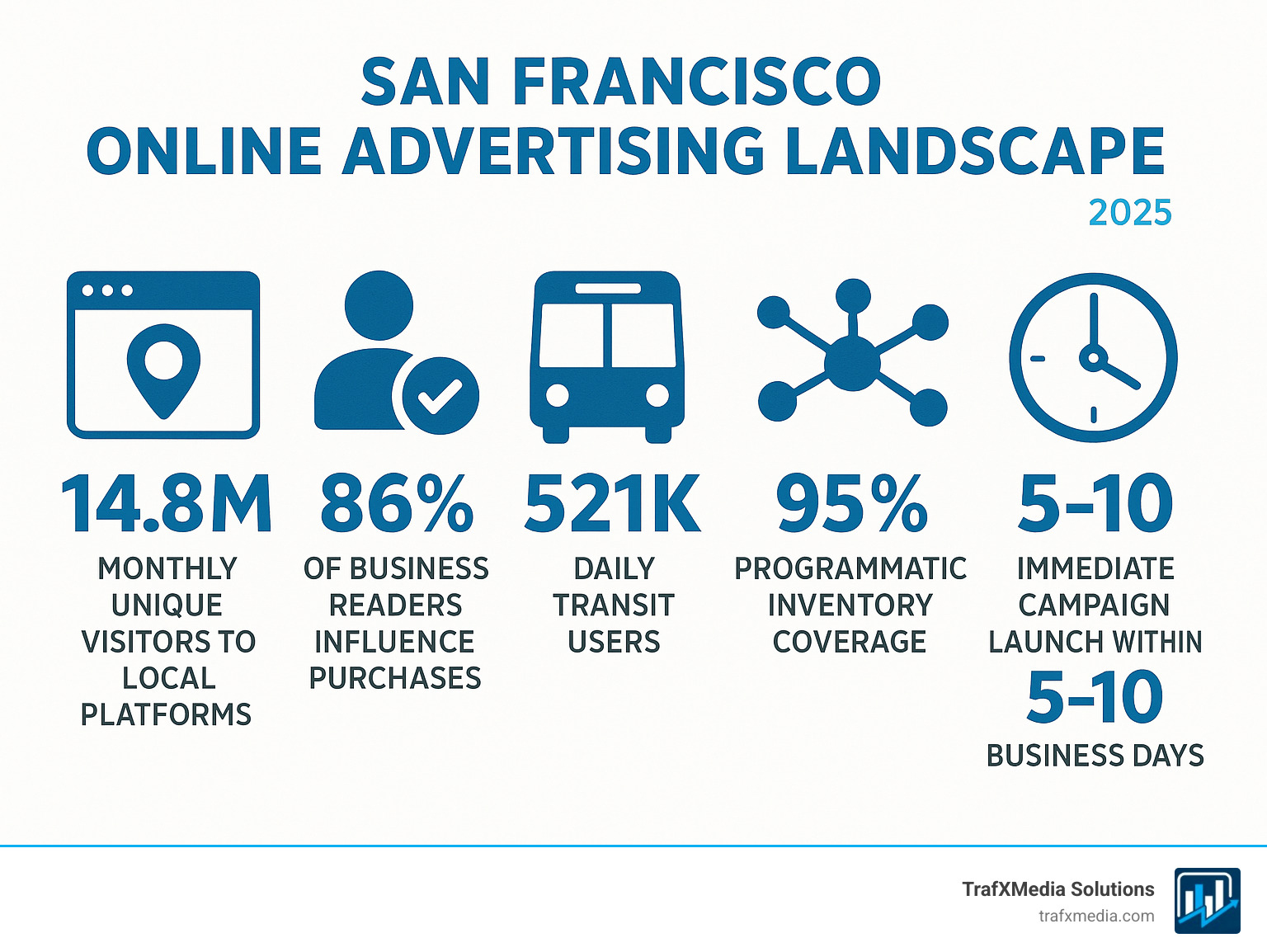
- Digital demand: Local guides earn 1 million+ daily hits, while top Bay Area platforms reach 14.8 million unique visitors monthly.
- Conversion reality: Only 1–2 % of website visitors buy on the first visit, so retargeted ads are critical.
Traditional media alone no longer delivers ROI. Modern, data-driven campaigns reach residents while they scroll, search, and stream— exactly when they are ready to act.
The competitive landscape in San Francisco is unlike anywhere else in the world. With tech giants like Google, Facebook, and Twitter headquartered in the Bay Area, local businesses face unique challenges and opportunities. The city’s residents are early adopters of new technologies, making them ideal targets for innovative digital advertising approaches. They expect seamless user experiences, personalized content, and instant gratification— all of which online advertising can deliver when executed properly.
Moreover, San Francisco’s diverse neighborhoods each have distinct characteristics and consumer behaviors. From the luxury shopping districts of Union Square to the artisanal coffee culture of the Mission, successful online advertising campaigns must account for these micro-markets within the larger metropolitan area. Understanding these nuances is crucial for businesses looking to maximize their advertising spend and achieve meaningful results.
The city’s high cost of living also means that residents have significant disposable income but are selective about their purchases. They research extensively before buying, compare options across multiple channels, and value brands that align with their personal values. This creates both an opportunity and a challenge for advertisers— while the potential for high-value customers exists, the competition for their attention is fierce.
Richard Taylor and TrafXMedia Solutions combine technical SEO and paid media expertise to craft strategies that turn those online moments into measurable growth for San Francisco businesses.
Glossary:
Introduction: Why Your SF Business Needs to Be Online

Picture your ideal customer in a Mission District café. They pull out a phone, search for what you sell, and tap the first result they trust. If you have invested in online ads San Francisco, that tap can be yours.
Bay Area residents are mobile-first, research-driven, and expect instant answers. With a median household income of $87,000 and a highly educated workforce, their choices are deliberate. Digital ads put your offer in front of them at the decisive moment—whether they are on the bus, in the office, or relaxing at home.
The city generates roughly 294 million ad impressions every week. By embracing online channels, even small companies can stand out in this competitive landscape and claim a share of that attention.
For context on the city itself, see this quick overview of San Francisco.
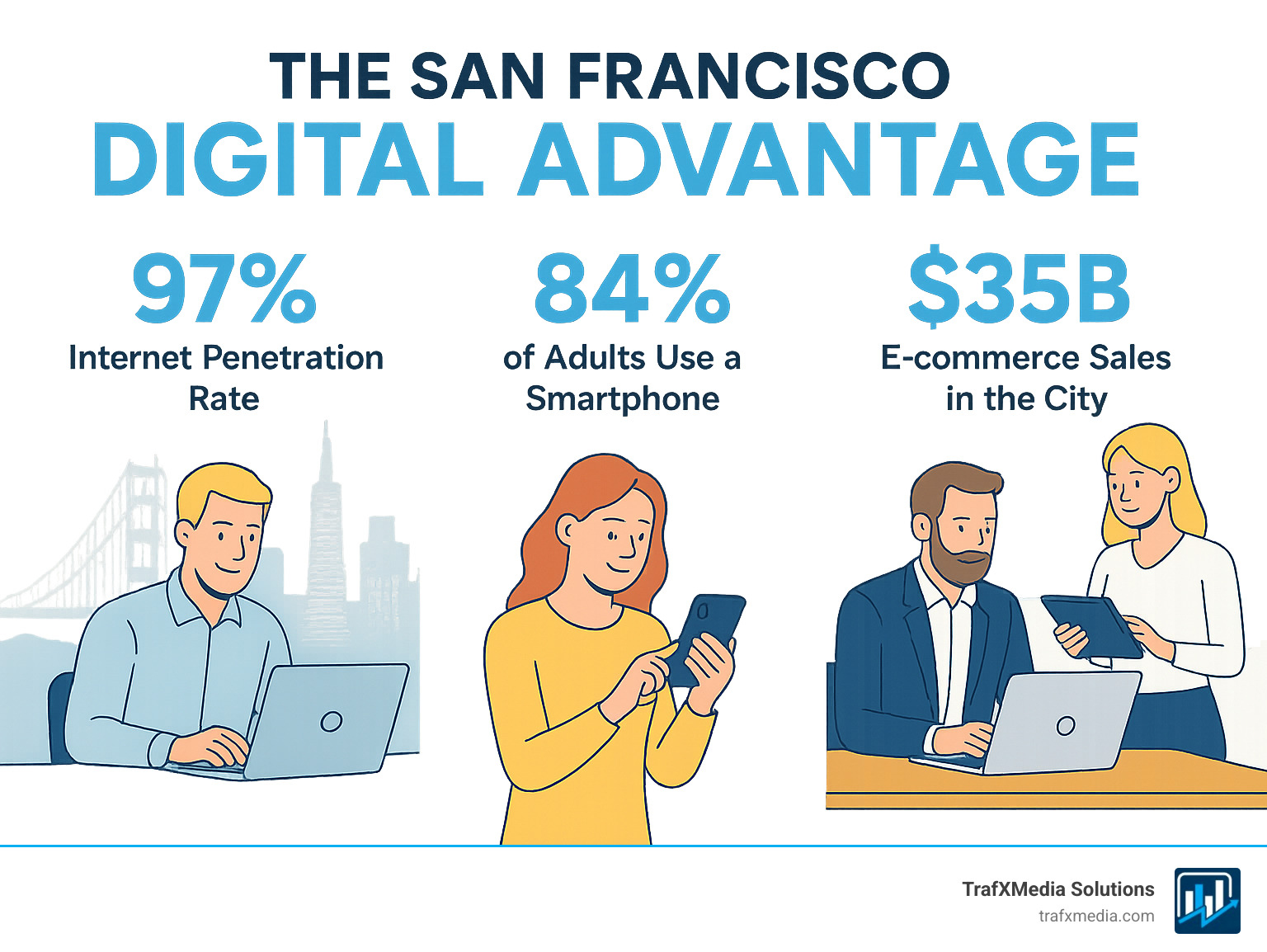
Opening Growth: Your Guide to Online Ads San Francisco

Digital advertising is a conversation with thousands of potential buyers at once. A full-funnel plan moves prospects from first glance to loyal customer:
- Brand awareness – introduce your name to locals who may not know you yet.
- Lead generation – capture people actively comparing options.
- Customer acquisition – turn those leads into paying clients.
- ROI – measure every dollar that returns with friends.
Core Ad Types
- Search Engine Marketing (SEM) – show up the moment someone Googles your service.
- Social Media Advertising – target by interests, lifestyle, and behaviors on Facebook or Instagram.
- Display Advertising – keep your brand visible on news, weather, and blog sites.
- Video Advertising – build trust through YouTube or streaming spots.
- Native Advertising – educate with sponsored articles that match editorial style.
- Programmatic Advertising – automate placements across 95 % of ad inventory for maximum reach.
Understanding Search Engine Marketing in Detail
Search Engine Marketing represents the most direct path to capturing high-intent customers in San Francisco. When someone searches for “best Italian restaurant North Beach” or “emergency locksmith SOMA,” they’re expressing immediate need. SEM places your business at the top of those results, often generating click-through rates 2-3 times higher than other digital advertising formats.
Google Ads dominates the SEM landscape, but Bing Ads shouldn’t be overlooked— especially for B2B companies targeting older demographics or specific professional sectors. The key to SEM success lies in keyword research that goes beyond obvious terms. Long-tail keywords like “organic dry cleaning service Castro district” often convert better than broad terms like “dry cleaning” because they capture more specific intent.
Bid management in San Francisco’s competitive market requires sophisticated strategies. Peak hours (7-9 AM and 5-7 PM) see bid prices spike as commuters search on mobile devices. Smart campaigns adjust bids automatically based on device, location, and time of day to maximize efficiency.
Social Media Advertising Strategies
Social media advertising in San Francisco requires understanding the unique cultural dynamics of the city. Instagram performs exceptionally well for lifestyle brands, restaurants, and retail businesses, while LinkedIn dominates B2B lead generation. Facebook’s detailed targeting options allow businesses to reach specific neighborhoods, interests, and behaviors with surgical precision.
The visual nature of social media advertising means creative assets must be compelling and authentic. San Francisco residents are particularly sensitive to overly promotional content, preferring brands that tell stories and demonstrate genuine value. User-generated content and local influencer partnerships often outperform traditional advertising creative.
Timing is crucial for social media success. Posting schedules should align with local commute patterns, lunch breaks, and evening leisure time. Analytics show that engagement peaks during MUNI commute hours and weekend mornings when residents are planning their activities.
Active vs. Passive Reach
- Search ads capture high-intent users (“emergency plumber SF”).
- Social and display ads build demand among people not yet searching.
- Combine both to cover the entire customer journey.
Advanced Targeting Techniques
San Francisco’s tech-savvy population provides unique opportunities for sophisticated targeting. Behavioral targeting can identify users based on their app usage, website visits, and online purchase history. For example, a fitness studio might target users who frequently visit health and wellness websites, have downloaded fitness apps, and live within a specific radius of their location.
Demographic targeting goes beyond basic age and gender. Income targeting is particularly relevant in San Francisco, where household incomes vary dramatically between neighborhoods. A luxury service provider might target households earning over $150,000 annually, while a budget-conscious business might focus on younger demographics or specific zip codes.
Interest-based targeting allows businesses to reach users based on their hobbies, preferences, and lifestyle choices. A sustainable fashion brand might target users interested in environmental causes, ethical consumption, and local artisan products— all highly relevant interests in San Francisco’s conscious consumer market.
Blending Online and Offline

Digital billboards, MUNI ads, and posters reach 521,000 daily transit riders— many of whom search your brand seconds later. Consistent messaging across screens and streets multiplies impact.
The integration of online and offline advertising creates powerful synergies in San Francisco’s transit-heavy environment. QR codes on bus stops and subway platforms can instantly connect offline viewers to online experiences. Location-based mobile advertising can target users who have recently passed physical advertising locations, creating a seamless omnichannel experience.
Event marketing also plays a crucial role in San Francisco’s advertising ecosystem. The city hosts numerous conferences, festivals, and cultural events throughout the year. Businesses can leverage geo-fencing technology to target attendees with relevant mobile ads, creating timely and contextually relevant advertising experiences.
Crafting a Winning Campaign Strategy
Success with online ads San Francisco starts with a clear roadmap.
- Target audience: Define precise buyer personas— age, job, neighborhood, and online habits.
- Goals & KPIs: Set specific numbers (calls, forms, sales) and track click-through rate, cost per lead, and return on ad spend.
- Creative: Eye-catching headlines, relevant visuals, and a strong call-to-action.
- Landing pages: Fast, mobile-friendly, and aligned with ad promises.
- A/B tests: Continual experiments on copy, images, and bidding keep campaigns improving.
Deep Dive into Buyer Persona Development
Creating effective buyer personas for San Francisco requires understanding the city’s unique demographic composition. The typical San Francisco consumer is highly educated, tech-literate, and values authenticity and social responsibility. However, this broad characterization masks significant diversity across neighborhoods and industries.
For B2B companies, personas might include the startup founder in SOMA working 80-hour weeks and making quick decisions via mobile, or the established corporate executive in the Financial District who prefers detailed proposals and formal presentations. Each persona requires different messaging, timing, and channel strategies.
Consumer-focused businesses must account for the city’s transient population. Many residents are transplants from other regions, bringing diverse cultural backgrounds and consumption patterns. Young professionals in tech might prioritize convenience and premium experiences, while families in the Sunset district might focus on value and community connections.
Psychographic profiling adds another layer of sophistication. San Francisco residents often identify strongly with environmental causes, social justice, and innovation. Brands that authentically align with these values often see higher engagement rates and customer loyalty.
Advanced Goal Setting and KPI Framework
Setting meaningful goals requires understanding the customer journey complexity in San Francisco’s competitive market. A typical B2B sale might involve 7-12 touchpoints across multiple channels before conversion. Consumer purchases, especially for high-consideration items, often involve extensive online research followed by in-store visits.
Micro-conversions become crucial metrics in this environment. Email signups, content downloads, store locator searches, and social media follows all indicate progress toward eventual sales. Advanced attribution modeling helps businesses understand which touchpoints contribute most to final conversions.
Return on Ad Spend (ROAS) calculations must account for customer lifetime value, not just initial purchase amounts. A restaurant might accept a lower ROAS for first-time customers, knowing that repeat visits and referrals will generate long-term profitability.
Creative Strategy for San Francisco Audiences
Creative development for San Francisco audiences requires balancing professionalism with authenticity. The city’s residents are sophisticated consumers who can quickly identify and reject overly salesy or inauthentic messaging. Successful creative strategies often incorporate local landmarks, cultural references, and community values.
Visual elements should reflect the city’s diversity and progressive values. Stock photography featuring only one demographic rarely resonates with San Francisco audiences. Instead, creative assets should showcase the city’s multicultural character and inclusive spirit.
Messaging must address the practical realities of San Francisco life. References to public transportation, parking challenges, and neighborhood-specific concerns demonstrate local understanding and build credibility with potential customers.
Pinpointing Your SF Audience
- Geo or zip-code targeting down to a single block.
- Demographic and behavioral filters for education level, industry, or interests.
- Messaging custom to distinct areas like the Marina, SOMA, or Noe Valley.
Neighborhood-Specific Targeting Strategies
Each San Francisco neighborhood has distinct characteristics that smart advertisers can leverage. The Marina attracts young professionals with disposable income who value fitness, nightlife, and luxury experiences. Advertising messages emphasizing premium quality, convenience, and social status often perform well in this area.
SOMA’s tech worker population responds to efficiency, innovation, and time-saving solutions. B2B services, productivity tools, and premium convenience services find receptive audiences here. The neighborhood’s rapid gentrification also creates opportunities for home services, interior design, and lifestyle brands.
The Mission’s artistic and Latino communities value authenticity, social responsibility, and cultural connection. Brands that demonstrate genuine community involvement and cultural sensitivity often build strong followings in this neighborhood.
Noe Valley’s family-oriented demographic prioritizes safety, education, and community. Services related to childcare, education, home improvement, and family activities perform well when targeted to this area.
Choosing Platforms
| Platform | User Intent | Best Use | SF-Specific Considerations |
|---|---|---|---|
| Google Ads | High | Immediate leads | High competition drives up costs |
| Facebook/Instagram | Medium–Low | Awareness & lifestyle persuasion | Strong performance for local businesses |
| YouTube | Medium | Education & credibility | Tech-savvy audience appreciates quality content |
| Display/Remarketing | Low | Staying top-of-mind | Premium inventory available on local sites |
| Professional | B2B outreach | Exceptional reach in tech industry | |
| TikTok | Low-Medium | Brand awareness for younger demographics | Growing influence among Gen Z consumers |
| Snapchat | Low | Location-based promotions | Popular for event marketing |
Platform-Specific Optimization Strategies
Google Ads success in San Francisco requires aggressive bid management and negative keyword strategies. The high cost-per-click environment means that poorly optimized campaigns can quickly exhaust budgets without generating meaningful results. Quality Score optimization becomes crucial for maintaining competitive positions at reasonable costs.
Facebook and Instagram advertising benefits from San Francisco’s highly engaged social media population. The city’s residents frequently share experiences, recommendations, and opinions online, creating opportunities for viral organic reach beyond paid promotion. User-generated content campaigns often generate exceptional ROI in this environment.
LinkedIn’s effectiveness for B2B marketing in San Francisco cannot be overstated. The platform’s professional targeting options allow precise reach into specific companies, job titles, and industries. Given the city’s concentration of decision-makers and influencers, LinkedIn campaigns often generate higher-quality leads despite higher costs per click.
Launch & Management Checklist
- Strategy and budget approval.
- Audience and keyword research.
- Creative build and compliance review.
- Landing page optimization and mobile testing.
- Tracking and analytics setup.
- Launch (usually within 5–10 business days).
- Daily monitoring for first week.
- Weekly optimization and performance analysis.
- Monthly reporting and strategy refinement.
- Quarterly campaign audits and strategic pivots.
Advanced Campaign Management Techniques
Successful campaign management in San Francisco’s environment requires real-time optimization capabilities. Automated bidding strategies can help manage the complexity of multiple campaigns across various platforms, but human oversight remains crucial for strategic decisions and creative optimization.
Seasonal adjustments play a significant role in San Francisco advertising. Tourist seasons, conference schedules, and local events all impact advertising performance. Smart campaign managers build these patterns into their optimization strategies, adjusting budgets and targeting parameters proactively rather than reactively.
Competitive intelligence becomes particularly important in San Francisco’s concentrated business environment. Monitoring competitor advertising strategies, messaging, and promotional offers helps businesses maintain competitive advantages and identify market opportunities.
Measuring and Maximizing Your Results

Data is your GPS. Key metrics:
- Click-Through Rate (CTR) – are ads compelling?
- Conversion Rate – do clicks become calls, forms, or sales?
- Cost per Lead / Sale – are you profitable?
- Attribution – credit each channel’s role in the sale.
Typical Outcomes in San Francisco
- Law firm: 29 qualified inquiries in month 1 with a 33 % click-to-lead rate.
- HVAC company: 48 calls monthly; one-third became service visits.
- Remarketing: 2–3× higher CTR than standard display ads.
Continuous optimization—weekly tweaks and monthly deep dives—keeps performance climbing.
Frequently Asked Questions about Online Advertising in the Bay Area
How is SEO different from paid search ads?
SEO earns free, long-term rankings; paid search buys instant top placement. Used together, they reinforce each other and accelerate results for online ads San Francisco campaigns.
When will I see results?
Traffic appears within days of launch. Meaningful lead flow typically stabilizes after 2–4 weeks of data collection and optimization.
Can I target specific neighborhoods?
Yes. Platforms let you include or exclude zip codes, draw custom radii, or target only people who live, work, or travel through a precise area—ideal for hyper-local businesses.
What kind of budget should a small business in SF expect to spend?
There’s no one-size-fits-all answer, as your budget for online ads in San Francisco depends heavily on your industry, the competitiveness of your keywords, and your specific growth goals. However, due to the high cost of living and intense competition, advertising costs in the Bay Area are significantly higher than the national average. For a small local business, a starting budget for a focused Google Ads or social media campaign might range from $1,500 to $5,000 per month. Highly competitive sectors like legal, real estate, or B2B tech may require budgets exceeding $10,000 per month to achieve meaningful traction. The key is to start with a test budget you’re comfortable with, focus on a narrow target audience, and carefully track your Return on Ad Spend (ROAS). As you gather data and prove profitability, you can scale your investment confidently.
How does the Bay Area’s privacy-conscious culture affect advertising?
San Francisco’s population is famously tech-savvy and privacy-aware, a sentiment reinforced by California’s landmark privacy laws like the CCPA and CPRA. This has profound implications for advertisers. Overtly intrusive or “creepy” retargeting can backfire, leading to negative brand perception. Successful campaigns prioritize transparency and value exchange. This means being clear about data usage, offering genuine value in exchange for user information (e.g., a helpful guide for an email signup), and respecting user consent. Furthermore, with the decline of third-party cookies, strategies that don’t rely on invasive tracking are becoming essential. This includes a renewed focus on high-quality content, contextual advertising (placing ads on relevant websites), first-party data collection, and building direct relationships with your audience through email lists and community engagement.
Is it better to hire a San Francisco-based agency or manage ads in-house?
The decision depends on your resources, expertise, and goals. Managing ads in-house provides maximum control and can be cost-effective if you have a skilled team member with dedicated time. However, the San Francisco market is exceptionally complex and competitive. A specialized San Francisco-based agency like TrafXMedia Solutions offers several advantages: deep local market knowledge, experience navigating high-cost ad auctions, access to enterprise-level tools and analytics platforms, and a team of specialists across different disciplines (SEM, social, creative). An agency can often accelerate results and avoid costly mistakes that a less experienced in-house team might make. For most businesses aiming for significant growth, partnering with a local agency provides a strategic edge that justifies the investment.
Conclusion: Take Your San Francisco Business to the Next Level
Online ads San Francisco open up access to an affluent, decision-making audience already searching for solutions. With clear goals, precise targeting, compelling creative, and relentless optimization, TrafXMedia Solutions turns those searches into revenue.
Your customers are online right now. Make sure they find you—before they find someone else.
Ready to move forward? Learn how to master Google Ads for your San Francisco business.