
Brighten Your Practice: Google Ads Strategies for Dental Clinics
Why Google Ads are a Game-Changer for Dental Practices
In today’s digital-first world, the patient journey begins online. Gone are the days of relying on phone books or local newspaper ads. Modern patients turn to Google the moment they need dental care, whether it’s for a routine check-up, a cosmetic procedure, or a painful emergency. This is where Google ads for dentists become an indispensable tool for practice growth. They are a powerful way to connect with patients actively searching for dental services in your area. Unlike traditional marketing, which broadcasts a message to a wide, often uninterested audience, Google Ads places your practice directly in front of people who have already raised their hands and expressed a need for dental care, making it one of the most effective and efficient patient acquisition strategies available.
Key benefits of Google Ads for dentists:
- Immediate Visibility: While search engine optimization (SEO) is a crucial long-term strategy, it can take months or even years to rank on the first page. Google Ads catapults your practice to the top of the search results instantly, giving you immediate visibility for your most important keywords.
- High-Intent Targeting: You reach patients at the exact moment they are searching for your services. This high-intent audience is far more likely to convert into a booked appointment compared to passive audiences reached through other forms of advertising.
- Precise Budget Control: You have complete control over your advertising spend. You can set daily or monthly budgets, and you only pay when someone clicks on your ad (the Pay-Per-Click model). This allows for predictable spending and the ability to scale your campaigns up or down based on performance and practice goals.
- Measurable Results: Every aspect of a Google Ads campaign is trackable. We can measure impressions, clicks, phone calls, form submissions, and appointment bookings. This data provides clear insight into your return on investment (ROI) and allows for continuous optimization to improve results over time.
- Hyper-Local Focus: For a dental practice, attracting local patients is paramount. Google Ads allows you to target specific geographic areas, from entire cities down to specific zip codes or even a radius around your practice, ensuring your marketing dollars are spent on reaching patients who can actually visit your office.
The dental landscape is increasingly competitive. With more practices vying for the same patients, digital advertising through Google’s Pay-Per-Click (PPC) platform allows you to cut through this competition by targeting high-intent patients who are actively searching for dental services like “emergency dentist near me” or “teeth whitening San Francisco.”
According to industry data, Google Ads drives 50% more conversions than organic search and grabs nearly two-thirds of all clicks on search results pages. For dental practices, this translates to a steady stream of qualified leads and new patient appointments. Properly managed Google Ads can transform a practice’s patient acquisition strategy, and our expertise is in helping healthcare practices optimize their digital presence to achieve measurable growth through these strategic campaigns.
Essential Google ads for dentists terms:
Why Google Ads are Essential for Your Dental Practice
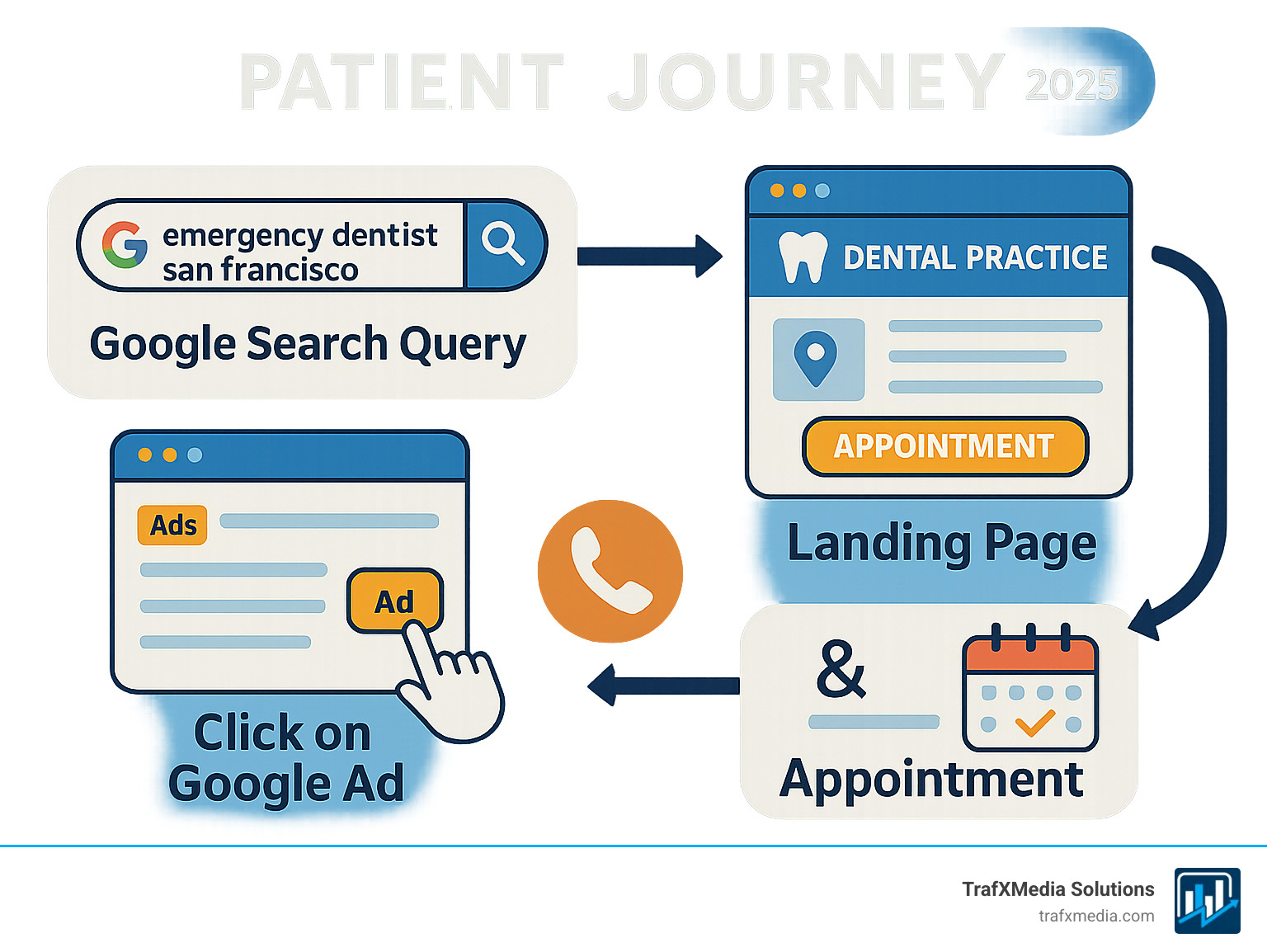
Imagine a potential patient in San Francisco has a sudden toothache. What’s the first thing they do? They likely pull out their phone and type “emergency dentist San Francisco” into Google. This is where Google ads for dentists truly shine. With a well-crafted ad, your practice can appear at the top of their search results, making you the first and most visible choice for leads who need help most.

Google Ads works on a Pay-Per-Click (PPC) model, meaning you only pay when someone clicks your ad. This system operates like an auction. When a user searches for a keyword you’re targeting, Google runs a real-time auction among all advertisers bidding on that keyword. The winners are determined not just by their bid amount, but also by their Ad Rank, a score that includes your bid, your ad’s Quality Score, and the expected impact of ad assets. This means a highly relevant ad can win a top spot even with a lower bid. It’s a smart way to use your marketing budget because you’re only paying for interested people. Our goal is to attract local patients actively searching for dental services, turning online searches into real appointments.
The magic of Google Ads lies in its measurable results. Unlike a billboard or a radio spot, you can track how many people saw your ad, clicked it, and became new patients. This data helps us constantly improve your campaigns for the best return on investment (ROI). Google Ads drives significantly more conversions than organic search, showing its power to bring in solid leads. When people are much more likely to click your ad on Google, it’s clear where your focus should be.
The Difference Between Ads and Organic Search
While organic search results (SEO) are key for long-term online presence and building authority, Google ads for dentists offer special advantages in user intent and speed to results. Google Ads lets us place your practice right in front of high-intent users at the exact moment they are looking for a solution.
Think of organic search as planting a tree: it takes time, consistent effort, and patience to grow and bear fruit. Google Ads is like turning on a lamp: you get immediate light exactly where you need it. You get top-of-page placement instantly, letting you skip the long process of ranking organically for competitive keywords. However, the most powerful strategy combines both. A strong SEO presence builds trust and credibility, while PPC captures immediate demand. When a potential patient sees your practice in both the paid and organic results, it significantly boosts their confidence in your brand, increasing the likelihood they’ll click and book an appointment.
Furthermore, Google Ads gives you amazing budget control. You set spending limits so you never overspend. This flexibility means we can adjust campaigns based on your practice’s needs. The targeting capabilities are also incredibly precise. We can narrow your audience by location (zip code, city, radius), keywords, time of day, and device. We can even layer on more advanced targeting, such as demographics (age, parental status), in-market audiences (users Google has identified as actively shopping for dental services), and remarketing lists to re-engage users who have previously visited your website.
Key Industry Benchmarks
Understanding typical industry results helps set realistic expectations. While every dental practice is unique, these averages offer a helpful guide for Google ads for dentists.
Let’s break down what these metrics mean for your practice:
- Average Click-Through Rate (CTR): This is the percentage of people who click your ad after seeing it. A higher CTR indicates that your ad copy is compelling and relevant to the search query. For dentists, a strong CTR means you’re effectively capturing the attention of potential patients.
- Average Cost Per Click (CPC): This is the amount you pay each time someone clicks your ad. In the dental industry, CPCs can be higher than in other sectors because you are competing for high-value patients. A single new implant or Invisalign patient can generate thousands of dollars in revenue, justifying the investment in each click.
- Average Conversion Rate (CVR): This is the percentage of clicks that result in a desired action, such as a phone call or a submitted appointment request form. This is one of the most important metrics. A high CVR means your ads and landing pages are working together effectively to turn clicks into leads.
These numbers, based on the Dentist & Dental Services industry, show how effective Google Ads can be. A strong return on investment (ROI) for Google Ads campaigns shows the significant potential for growth. These data-driven expectations help guide our strategy to ensure your investment brings you the best possible results.
Building Your Winning Campaign: Core Elements of Google Ads for Dentists
Building a great Google ads for dentists campaign is like assembling a puzzle. It requires a thoughtful approach, focusing on a strong campaign structure, the right keywords, and compelling ads. The Google Ads account hierarchy is organized logically: Account > Campaign > Ad Group > Ads & Keywords. We design your account with a clear plan: separate campaigns for different services (e.g., General Dentistry, Cosmetic, Implants) or geographic locations. Within each campaign, we create tightly-themed ad groups. For example, an “Implants” campaign might have ad groups for “single tooth implant cost” and “all-on-4 dental implants.” This organization helps us use your budget allocation wisely, tailor ad copy precisely to the search query, and achieve high ad relevance. This leads to a better Quality Score, lower costs, and more qualified leads. For practices with multiple locations, we set up unique campaigns for each one, custom to their local patients.
Strategic Keyword Selection for Your Dental Practice
The secret to a successful Google ads for dentists campaign is smart keyword research. We need to think like potential patients. What are they typing into Google? We dig deep to find keywords for your high-value services, like “dental implants cost,” “Invisalign near me,” or “cosmetic dentist San Francisco.” These phrases show someone is serious about booking an appointment. Our research focuses on a few key types:
- Local keywords: Phrases like “dentist San Francisco” or “family dentist Potrero Hill” are crucial for reaching patients in your neighborhood.
- Service-specific keywords: Targeting terms like “zoom teeth whitening” or “porcelain veneers” attracts users looking for specific treatments.
- Long-tail keywords: Longer, specific phrases like “emergency wisdom tooth extraction San Francisco” often have less competition and higher conversion rates because the user’s intent is very clear.
- Scheduling intent keywords: We look for keywords that show a user is ready to book, such as “dental cleaning appointment,” which shows more intent than “how to clean teeth.”
We use professional tools, like the Google Keyword Planner, Ahrefs, and SEMrush to find these important words. This helps us see search volumes and competition levels, so we can pick keywords that not only get your ads seen but also bring in patients who truly need your services.

Understanding Keyword Match Types
Choosing the right keyword match type is critical for controlling your budget and reaching the right audience. Google offers three main types:
- Broad Match: Shows your ad for searches that are related to your keyword, including synonyms, misspellings, and related topics. While it offers the widest reach, it can lead to significant wasted ad spend on irrelevant clicks if not managed carefully with negative keywords.
- Phrase Match: Shows your ad for searches that include the meaning of your keyword. For example, the phrase match keyword “emergency dentist” could show for searches like “emergency dentist near me” or “find a local dentist for an emergency.” This offers a good balance of reach and control.
- Exact Match: Shows your ad only for searches that have the same meaning or intent as your keyword. The exact match keyword [dentist in san francisco] would only show for very similar searches like “san francisco dentist.” This provides the most control and typically yields the highest conversion rates, but has the most limited reach.
A sophisticated strategy uses a mix of these match types, starting with Phrase and Exact match for core services to ensure high relevance and gradually testing Broad match in separate, controlled campaigns to find new, valuable search queries.
The Critical Role of Negative Keywords
While finding the right keywords is key, it’s just as important to exclude the wrong ones. This is where negative keywords are essential. They stop your ads from showing for irrelevant searches, preventing wasted ad spend. Imagine your ad for “teeth whitening” appearing for searches like “teeth whitening DIY.” Those clicks won’t become patients and will cost you money. We build comprehensive negative keyword lists from the start and continuously update them by analyzing the Search Terms Report, which shows the actual queries that triggered your ads. This process of query filtering is vital for campaign health, boosting your ad relevance and Quality Score, which can lower your cost per click.
Here are some common negative keyword categories for dentists:
- Informational/DIY: how to, DIY, training, school, course, what is
- Low-Value: free, cheap, affordable (unless it’s part of your strategy), pro bono
- Job Seekers: jobs, careers, employment, salary, hiring
- Competitors: We typically add competitor practice names as negatives to focus the budget on attracting new patients, not engaging in bidding wars (unless a specific competitor conquesting strategy is in place).
- Irrelevant Terms: pictures, images, videos, reviews (unless targeting your own practice’s reviews)
Crafting Compelling Ad Copy and Using Ad Assets
Once we have our keywords, it’s time to write ad copy that shines. This is your chance to convince a potential patient to click your ad. Great ad copy for Google ads for dentists is clear, concise, and convincing. We primarily use Responsive Search Ads (RSAs), which allow us to provide multiple headlines and descriptions. Google’s machine learning then tests different combinations to find the best-performing ad for each user.
- Headlines: We use strong, keyword-rich headlines that match the user’s search, create a sense of urgency (“Limited Appointments Available”), and highlight benefits (“Get Your Confident Smile Back”).
- Descriptions: We explain what makes your practice special—your experienced team, advanced technology, patient comfort amenities, or new patient specials.
- Unique Selling Proposition (USP): We weave your unique differentiators into the ad copy. Do you offer sedation dentistry? Are you a top-rated Invisalign provider? We make it known.
- Call to Action (CTA): A clear CTA like “Book Online Today” or “Call Now for an Appointment” tells the user what to do next.

Beyond the main text, ad assets (formerly ad extensions) make your ad bigger, more informative, and more clickable. We use a full suite of assets to maximize your ad’s screen real estate and performance:
- Sitelinks: Extra links to specific pages like “Dental Implants,” “New Patient Forms,” or “Meet Our Team.”
- Callouts: Short snippets to highlight key features like “5-Star Rated,” “Same-Day Appointments,” or “Accepting New Patients.”
- Call Extensions: Adds your phone number, allowing mobile users to call with one tap.
- Location Extensions: Displays your address, hours, and a map link, crucial for attracting local patients.
- Structured Snippets: Highlight specific services under a predefined header, like “Services: Implants, Veneers, Cleanings.”
- Image Extensions: Adds a relevant visual to your text ad, making it stand out on the results page.
- Promotion Extensions: Showcases special offers, like “$99 New Patient Special.”
These assets boost your ad’s Quality Score, which can lead to a higher position at a lower cost. We also add trust signals, like patient testimonials or ratings, to build confidence.
Optimizing for Success: Measuring ROI and Avoiding Pitfalls
Launching a Google ads for dentists campaign is a great first step, but the journey to patient growth requires continuous improvement and optimization. We constantly analyze data to see what’s working and what needs adjustment. This careful attention to detail ensures maximum campaign efficiency and contributes to your practice’s healthy long-term growth. True success comes from a cycle of measuring, learning, and refining.
Designing High-Conversion Landing Pages for Google Ads for Dentists
Your ad is only half the battle. If a potential patient clicks your ad for “Invisalign clear aligners” and lands on your general homepage, they might get confused, frustrated, and leave. That’s why landing page optimization is crucial. A dedicated, conversion-optimized landing page is designed with a single goal: to convert that click into a lead—a call, a form submission, or a booked appointment. The landing page must be a seamless continuation of the ad’s promise.
An effective landing page for Google ads for dentists must include these essential elements:
- Compelling Headline: The headline should match the ad copy and the keyword the user searched for, confirming they’re in the right place.
- Clear Call to Action (CTA): Use prominent buttons with action-oriented text like “Schedule Your Free Consultation” or “Book Your Appointment Now.” The CTA should appear multiple times on the page.
- Mobile-First Design: The vast majority of local searches happen on mobile devices. Your landing page must load quickly and be easy to steer on a small screen.
- Trust Signals: Build confidence with patient testimonials, video reviews, before-and-after photos, logos of associations you belong to (like the ADA), and photos of your friendly staff and modern office.
- Benefit-Oriented Copy: Don’t just list features; explain the benefits. Instead of “We use ceramic crowns,” say “Get a natural-looking, durable smile with our ceramic crowns.”
- Simple Lead Capture Form: Only ask for essential information: name, phone number, and email. A long, complicated form will kill your conversion rate.
- Click-to-Call Phone Number: Make your phone number prominent and clickable on mobile devices.
Sending traffic to a dedicated page instead of the homepage dramatically boosts your conversion rate. We even use A/B testing—creating two versions of a landing page and showing them to different users—to scientifically determine which headline, CTA, or image combination generates the most new patients.
Tracking and Measuring Your Return on Investment (ROI)
One of the best things about Google ads for dentists is how clearly you can see your results. We set up comprehensive conversion tracking to monitor every important action a user takes after clicking your ad. This includes phone call tracking (using dynamic number insertion to know which calls came from which campaign), online form submissions, and online appointment bookings.
Calculating your ROI helps you understand the financial impact of your marketing. The basic formula is: (Revenue from Ads - Ad Spend) / Ad Spend. To do this accurately, you need to know the average lifetime value (LTV) of a new patient. A patient who comes in for a $99 cleaning could become a long-term patient who gets thousands of dollars in treatment over several years. Understanding this LTV is key to evaluating the true success of your campaigns. We also closely monitor Return on Ad Spend (ROAS), which is a simpler metric: Revenue from Ads / Ad Spend. We constantly monitor key metrics like your Cost Per Click (CPC), Cost Per Lead (CPL), and Conversion Rate (CVR). These data-driven decisions guide us to continuously optimize your campaigns for the best possible return on your investment.
Common Pitfalls in Google Ads for Dentists and How to Avoid Them
It’s easy to stumble in Google Ads and waste your marketing budget. We help our clients steer clear of these common pitfalls:
- Wasted Ad Spend on Irrelevant Clicks: This happens when ads show for irrelevant searches due to poor keyword selection or a lack of negative keywords. We prevent this with tight keyword themes, proper match types, and a robust, ever-growing negative keyword list.
- Using Only Broad Match Keywords: Relying solely on broad match without careful monitoring is the fastest way to drain your budget on unqualified traffic. We use a strategic mix of match types for control and precision.
- Poor Geographic Targeting: Showing ads to people who live too far away to become patients is a waste. Our hyper-local approach ensures your message connects with local searchers within a reasonable driving distance of your practice.
- No Conversion Tracking: Running ads without tracking is like flying blind. You’re spending money without knowing what’s working. We set up robust tracking from day one so every decision is backed by data.
- Ignoring Quality Score: Quality Score is Google’s rating of the quality and relevance of your keywords and ads. It’s composed of Expected CTR, Ad Relevance, and Landing Page Experience. A low Quality Score leads to higher costs and lower ad positions. We constantly work to improve it.
- Failing to Use Remarketing: Not every website visitor is ready to book on their first visit. Remarketing allows you to show targeted ads to these past visitors as they browse other sites, reminding them of your practice and encouraging them to return and book an appointment.
- Ignoring Mobile Users: With so many people searching on phones, your ads and landing pages must be mobile-friendly. A poor mobile experience will lead to high bounce rates and lost opportunities. We ensure a seamless experience on any device.
Frequently Asked Questions about Google Ads for Dental Clinics
What is a realistic budget for dental Google Ads?
There isn’t a single magic number for a Google ads for dentists budget, as it’s highly dependent on your specific situation. The ideal amount varies by location, local competition, and your practice goals. A practice in a competitive urban market like San Francisco will need a larger budget to be visible than a practice in a smaller town with fewer competitors. The cost-per-click for high-value keywords like “dental implants” will also be higher than for “teeth cleaning.”
Instead of focusing on a specific number, we recommend focusing on your goals and return on investment (ROI). Are you aiming for aggressive growth or a steady flow of 10-15 new patients per month? We recommend starting with a test budget for the first 2-3 months that is large enough to gather meaningful data across different campaigns. Once we identify the most profitable campaigns and keywords, we can strategically scale your budget for optimal, profitable growth, ensuring every dollar you spend is working to grow your practice.
How quickly can I expect to see results from my campaign?
One of the most exciting parts of Google ads for dentists is the speed of results. You can expect immediate traffic and visibility as soon as your ads go live. Initial lead generation, such as phone calls and form submissions, often begins within the first week.
However, it’s important to distinguish between initial activity and peak performance. Achieving optimal performance and the best ROI typically takes an optimization period of about 60 to 90 days. Here’s a typical timeline:
- Month 1: Launch, data collection, and initial adjustments. We gather data on which keywords, ads, and targeting parameters are performing best and begin pruning what isn’t working.
- Month 2: Refinement and testing. We use the initial data to refine ad copy, adjust bids, expand on winning keywords, and test different landing page elements.
- Month 3: Scaling and optimization. By this point, we have a clear picture of what drives results. We focus on scaling the successful parts of the campaign to maximize your lead flow and ROI.
Think of it as a long-term strategy where quick wins build momentum towards consistent, predictable growth.
Should I run different campaigns for different dental services or locations?
Absolutely, yes. This is a fundamental best practice for Google ads for dentists. Segmenting your campaigns is essential for control, relevance, and performance. Running separate campaigns for different services (e.g., Implants, Invisalign, Emergency Care, General Dentistry) or for each of your multi-location practices provides several key advantages:
- Precise Budget Control: You can allocate more budget to your most profitable, high-value services or to a new location that needs to build its patient base faster.
- Higher Ad Relevance: You can write highly specific ads and create dedicated landing pages that speak directly to a patient’s need. Someone searching for “emergency dentist” will see an ad about same-day appointments, not a generic ad about your practice.
- Improved Tracking and Reporting: It’s much easier to analyze performance and calculate ROI for each specific service or location when they are in their own campaigns.
- Custom Messaging: The messaging for cosmetic dentistry (focused on aesthetics and confidence) is very different from emergency dentistry (focused on speed and pain relief). Separate campaigns allow for this crucial message tailoring.
What is Quality Score and why does it matter for my dental ads?
Quality Score is a diagnostic tool from Google, scored from 1 to 10, that measures the overall quality of your ads compared to other advertisers. It is a crucial factor in the ad auction. A higher Quality Score means Google sees your ad and landing page as highly relevant and useful to the user, and you’ll be rewarded with lower costs-per-click (CPCs) and better ad positions. The three main components are:
- Expected Click-Through Rate (CTR): How likely is a user to click your ad when it’s shown?
- Ad Relevance: How closely does your ad copy match the intent behind a user’s search?
- Landing Page Experience: Is your landing page relevant, easy to steer, and useful to the user who clicks the ad?
For a dental practice, a high Quality Score is critical for achieving a strong ROI. We focus on improving it by creating tightly-themed ad groups, writing compelling ad copy, and ensuring our landing pages provide an excellent user experience.
Should I bid on my own practice’s name (branded keywords)?
Yes, in most cases, bidding on your own practice name is a smart and cost-effective strategy. While you may rank #1 organically for your name, bidding on it provides several benefits:
- Own the Search Results Page: It allows you to dominate the top of the search results, pushing competitors further down the page. Some competitors may even bid on your name to try and steal your patients.
- Control Your Message: Paid ads give you complete control over the messaging. You can promote a new patient special or direct them to a specific landing page, which you can’t do with an organic listing.
- Cost-Effective Clicks: Clicks on your own brand name are typically very inexpensive because your Quality Score will be extremely high (10/10), as you are the most relevant result.
- Increased Overall Clicks: Studies have shown that having both a paid ad and an organic listing for a brand search increases the total number of clicks you receive. It acts as a powerful signal of authority and trust.
Conclusion: Your Prescription for Practice Growth
The digital landscape has transformed how patients find dental providers, and Google ads for dentists are the most effective prescription for sustainable practice growth. It’s no longer enough to be a great dentist; you must also be visible online at the exact moment a potential patient needs you. Through strategic management, you’re not just competing; you’re positioning your practice as the clear, trusted choice for patients actively seeking care in your community.
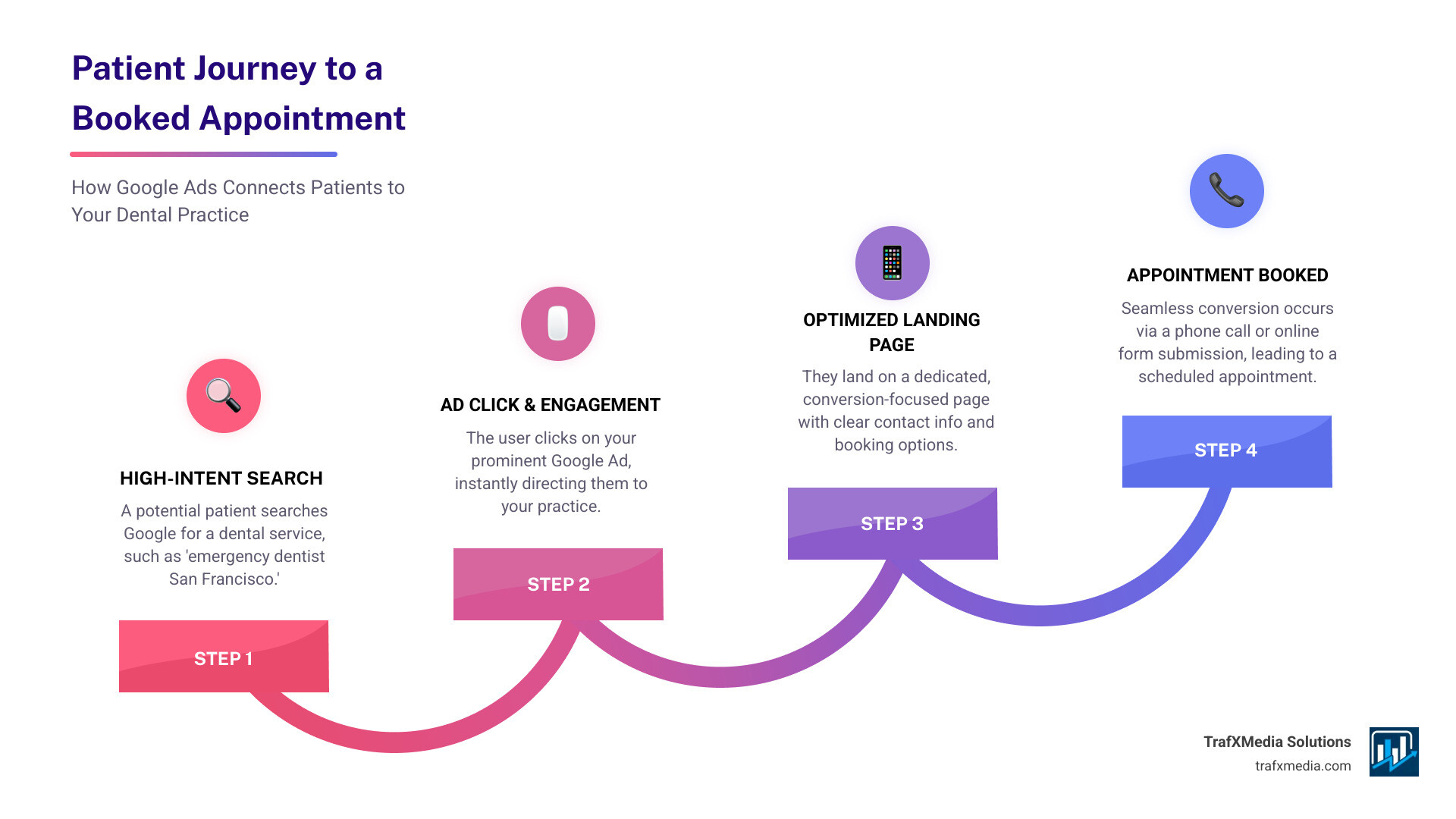
The power of Google Ads is its unparalleled ability to connect you with high-intent patients at their moment of need. This targeted approach to patient growth creates a steady, measurable stream of qualified leads that traditional marketing simply can’t match. The journey from a patient’s search query to a booked appointment is a complex one, requiring a sophisticated strategy that encompasses everything from meticulous keyword research and compelling ad copy to high-converting landing pages and rigorous data analysis. What sets successful practices apart is their ability to master this entire digital funnel, ensuring they are found by the right patients at the right time. Google ads for dentists provide this crucial competitive advantage, allowing you to appear instantly at the top of search results.
Managing a comprehensive Google Ads strategy is not a “set it and forget it” task. It requires constant attention, technical expertise, and deep data analysis to fend off competitors and maximize your return on investment. To effectively manage a comprehensive strategy and achieve measurable growth, many practices partner with an expert who understands both the technical nuances of the Google Ads platform and the unique challenges and opportunities within the dental industry.
At TrafXMedia Solutions, we understand your primary focus should be on providing exceptional dental care to your patients. As a San Francisco-based digital marketing agency, we specialize in creating personalized strategies for our local business community. Our approach to Google ads for dentists goes beyond generic templates; we craft bespoke campaigns that speak directly to your ideal patients, showcase what makes your practice unique, and drive tangible results.
Your practice deserves more than cookie-cutter marketing. Let us handle the complexities of digital advertising so you can focus on what you do best: creating healthy, beautiful smiles. Let us help you create a Google Ads strategy that attracts a consistent flow of new patients and builds a strong foundation for long-term, sustainable growth.
Get a custom Google Ads strategy for your San Francisco practice