
Learn to Earn: Google Ads for Education Success
Why Google Ads is Revolutionizing Student Recruitment
Google ads for education has become an indispensable tool for schools, colleges, and universities aiming to attract and enroll prospective students in the modern digital landscape. The days of relying solely on college fairs, print brochures, and high school visits are over. For any institution managing enrollment, leveraging Google’s powerful advertising platform is no longer just an option—it’s a fundamental component of a successful recruitment strategy.
The shift to digital is undeniable. With over 94% of prospective students, from high schoolers to adult learners, beginning their educational research online, a strong and visible digital presence is essential for survival and growth. This online journey involves searching for specific programs, comparing tuition costs, reading reviews, and taking virtual campus tours. Institutions that master Google ads for education gain a significant competitive advantage by appearing at the very top of search results at the exact moment a potential student expresses interest, instantly capturing their attention.
Key Benefits of Google Ads for Educational Institutions:
- Higher Conversion Rates: The education sector boasts an impressive average conversion rate of 3.39% on search ads, significantly outperforming the 2.7% average across all other industries. This indicates that the traffic driven by these ads is highly qualified and motivated.
- Precise, Granular Targeting: Move beyond broad-stroke advertising. Reach specific demographics (age, gender, parental status), geographic locations (down to the zip code), and user interests. This allows you to connect with ideal student candidates, whether you’re targeting local high school graduates or international students seeking specialized postgraduate degrees.
- Complete Budgetary Control: Google Ads operates on a flexible, pay-per-click (PPC) model. You set daily or monthly budgets that you’re comfortable with and only pay when a prospective student actually clicks on your ad, ensuring your marketing dollars are spent efficiently.
- Fully Measurable Results: Every action is trackable. Monitor every click, inquiry, application start, and completed enrollment to calculate your precise return on investment (ROI). This data-driven approach allows for continuous campaign refinement and optimization.
- Best Global Reach: With Google processing billions of searches per day and its network reaching over 90% of the internet population, your institution can achieve a level of visibility that was previously unimaginable through traditional marketing channels.
From targeting high school students searching for “best undergraduate business programs” to reaching working professionals looking for “online project management certificates,” Google Ads offers unparalleled precision in connecting educational institutions with their ideal students, revolutionizing the entire recruitment funnel.
Why Google Ads is an Essential Tool for Student Recruitment
Imagine a high school senior in a neighboring state searching for “best private university for engineering near me.” If your institution doesn’t appear in the top search results, for all practical purposes, it doesn’t exist for that student. In today’s digital-first world, Google ads for education serves as the critical bridge connecting your school’s offerings with the active search queries of prospective students. With Google’s massive, undeniable reach, it has become a non-negotiable tool for sustainable enrollment growth.
Compelling statistics underscore this necessity. Educational institutions using Google Ads see an average search ad conversion rate of 3.39%, a figure that is substantially higher than the cross-industry average. A “conversion” in this context is a valuable, measurable action—such as a submitted inquiry form, a phone call to the admissions office, or a downloaded program brochure. This high rate signifies that students clicking your ads are not just browsing; they are genuinely interested and ready to take the next step in their educational journey.
Understanding the Core Benefits
The true power of Google ads for education lies in its surgical precision and efficiency, a stark contrast to the scattergun approach of traditional advertising.
- Hyper-Targeted Reach: Go beyond basic demographics. Show your ads to users based on age, gender, parental status, and even household income tiers. For example, a community college can target adults within a 30-mile radius who are actively researching healthcare careers for a new nursing program. You can even target based on life events, such as “recently graduated from high school.”
- Best Cost-Effectiveness: The pay-per-click (PPC) model is inherently efficient. You only invest when someone demonstrates active interest by clicking your ad. Unlike Cost Per Mille (CPM) models where you pay for impressions, PPC ensures your budget is spent on engaging potential leads. Flexible budgeting allows you to start with a modest investment, prove ROI, and scale your campaigns confidently.
- Data-Driven, Measurable Results: Eliminate the guesswork from your marketing. Track every click, impression, conversion, and cost-per-acquisition back to specific campaigns, ad groups, and keywords. This wealth of data allows you to calculate your exact return on investment (ROI) and make informed decisions to continuously improve campaign performance.
- High-Intent Lead Generation: Capture warm leads at the peak of their interest—the exact moment they are actively searching for educational opportunities. This is fundamentally different from interruptive advertising; you are providing a solution at the precise time of need.
- Improved Brand Awareness and Recall: Even when users don’t click immediately, seeing your institution’s name at the top of relevant search results builds brand recognition and credibility. This repeated exposure can lead them to visit your site directly or search for your brand name later on.
The Competitive Edge in the Education Sector
In the competitive landscape of student recruitment, timing and visibility are critical. Google ads for education allows you to reach students first, right at the beginning of their research phase, giving you a clear and decisive advantage.
- Promote Niche and New Programs: Launching a new data science certificate or a specialized arts program? Create highly targeted ad campaigns that appear instantly for relevant searches like “data science bootcamp” or “MFA in creative writing.”
- Drive High-Quality Applications: Guide motivated prospects through a seamless and logical journey, from an initial search query directly to your optimized application or inquiry page, increasing the likelihood of conversion.
This strategic, data-backed approach doesn’t just fill empty seats; it attracts the right, best-fit students for your unique programs, laying the foundation for higher retention and student success, as detailed in resources like What are the Benefits of Google Ads in Education Industry?.
Mastering Google Ads for Education: From Strategy to Enrollment
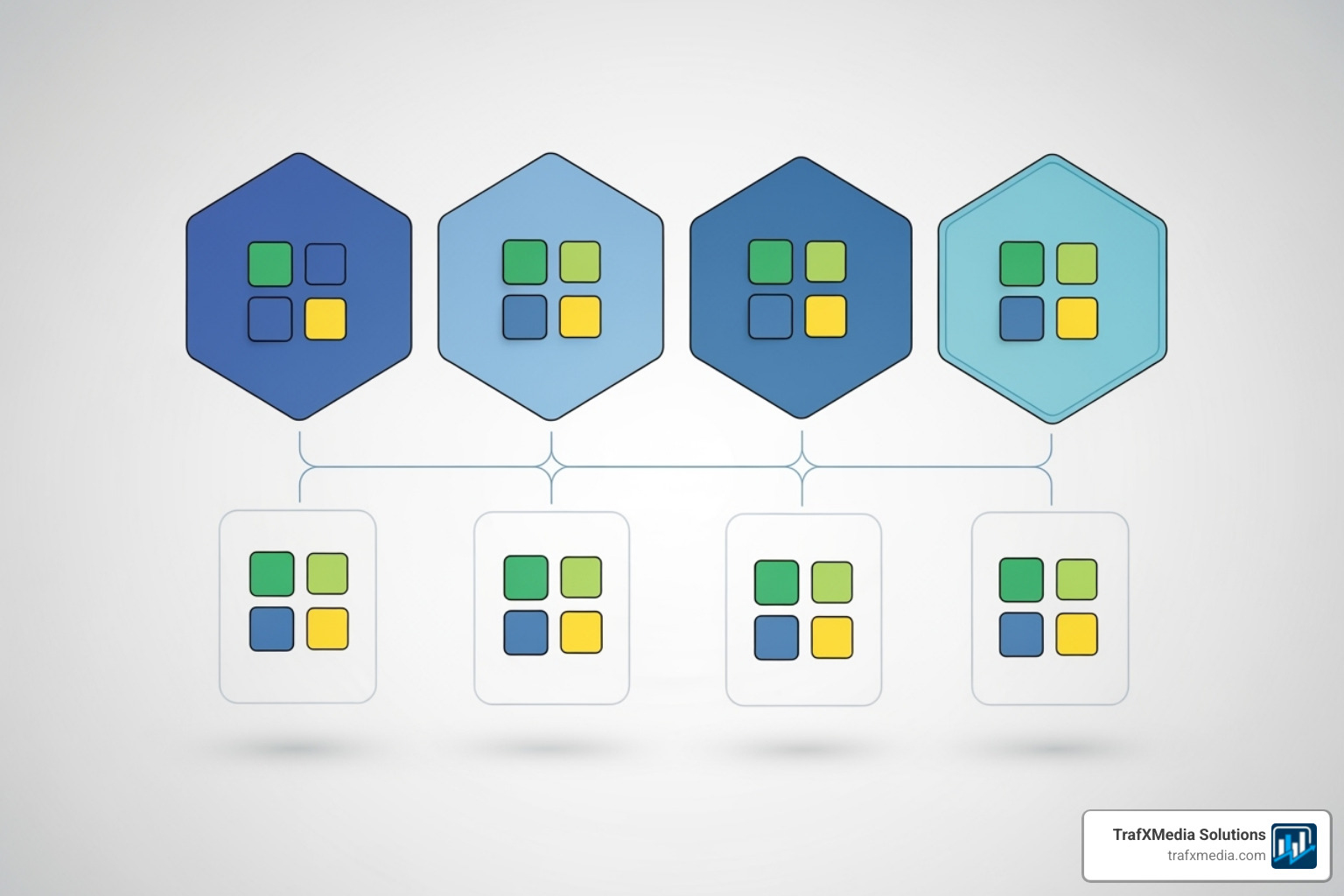
A successful Google ads for education campaign is not a matter of chance; it’s the result of a carefully planned strategy and a clear, logical structure that guides prospective students from search to enrollment. A well-organized account structure is the foundational blueprint for this journey, ensuring efficiency, control, and scalability.
Building a Logical Campaign Structure
Begin by organizing your campaigns around logical themes that mirror your institution’s offerings, such as undergraduate programs, graduate studies, online certificates, or international student recruitment. A crucial first step is to always keep search and display campaigns separate. This is non-negotiable because they target users with different levels of intent and require distinct bidding strategies, ad formats, and performance metrics. Mixing them dilutes control and muddies performance data.
Different campaign types serve distinct purposes in the student journey:
- Search Campaigns: The workhorse of lead generation. Capture high-intent students who are actively searching for specific programs with text-based ads in Google’s search results. This is where you connect with prospects closest to making a decision.
- Display Campaigns: Build brand awareness and retarget past website visitors. Use visually compelling image and banner ads across the Google Display Network (GDN), a collection of millions of websites, news pages, blogs, and Google sites like Gmail and YouTube.
- Video Campaigns: Tell your institution’s story and showcase campus life, student testimonials, and faculty expertise on YouTube. These are excellent for engaging students at the top and middle of the funnel, building an emotional connection.
- Performance Max Campaigns: Leverage Google’s AI to run ads across all channels (Search, Display, Video, Find, Gmail, and Maps) from a single campaign. This goal-based campaign type uses machine learning to find converting customers and maximize enrollments automatically.
Effective Targeting with Google Ads for Education
Reaching the right audience is the key to avoiding wasted ad spend. Google Ads offers a powerful suite of targeting options:
- Demographics: Target by age, gender, parental status, and even household income. For K-12 schools, targeting parents in specific age ranges and income brackets can be highly effective. Pro tip: Avoid excluding the “unknown” demographic category initially, as it can significantly limit your reach.
- Geographic Targeting: Focus your budget where it matters most. Target specific countries, states, cities, zip codes, or even set a radius around your campus to attract local, regional, or international students.
- In-Market Audiences: Reach users whose recent online behavior indicates they are actively researching and comparing educational services. Google categorizes these users into audiences like “Colleges & Universities” or “Vocational & Technical Schools,” making them prime targets.
- Custom Audiences: Get even more granular. Create audiences by targeting people based on specific websites they visit (e.g., competitor university sites) or keywords they’ve recently searched on Google.
- Life Events: Target users going through significant life milestones, such as “Graduating Soon” or “Recently Graduated from High School,” which are strong indicators of educational intent.
Keyword and Ad Group Optimization
Keywords are the fundamental link between your ads and what students are searching for. An effective keyword strategy is multifaceted:
- Thorough Keyword Research: Use tools like the Google Ads Keyword Planner to find relevant search terms, understand their search volume, and estimate their cost.
- Leverage Long-Tail Keywords: Use specific, multi-word phrases like “online MBA for working professionals” or “bachelor of science in nursing part-time.” These keywords typically have lower competition, are less expensive, and attract more motivated, high-intent prospects.
- Use Keyword Match Types: Control which searches trigger your ads. Use Broad Match for findy, Phrase Match for a balance of reach and relevance, and Exact Match for targeting highly specific queries with the best conversion potential.
- Protect Your Brand with Branded Keywords: Bidding on your own school’s name and program names is crucial. It’s typically inexpensive and yields a very high ROI, as it captures searchers who are already familiar with your institution and protects you from competitors bidding on your brand.
- Eliminate Waste with Negative Keywords: Actively build a list of irrelevant search terms to exclude. For a marine biology program, you might add negative keywords like “jobs,” “salary,” or “free courses” to avoid wasted ad spend on unqualified clicks.
- Maintain Relevance with Themed Ad Groups: Organize your keywords into tightly themed ad groups (e.g., “Business Degrees,” “Engineering Programs,” “Nursing Degrees”). This ensures your ads are highly relevant to the keywords in that group, which is a key factor in improving your Quality Score.
- Focus on Quality Score: This 1-10 metric from Google rates the quality and relevance of your keywords, ads, and landing pages. A high Quality Score is critical as it directly leads to lower costs per click and better ad positions. It is determined by three main components: Expected Click-Through Rate (CTR), Ad Relevance, and Landing Page Experience.
Crafting High-Converting Ads and Landing Pages
In Google ads for education, even the most sophisticated targeting and bidding strategy will fail if your ads don’t capture attention and your landing pages don’t drive action. Your ad is the crucial first impression—the invitation to learn more—and your landing page is the persuasive conversation that guides a prospective student toward application and enrollment.
Best Practices for Ad Copy in Google Ads for Education
Great ad copy is a concise, compelling, and benefit-driven pitch that speaks directly to the student’s needs and aspirations. Follow these best practices to make your ads stand out:
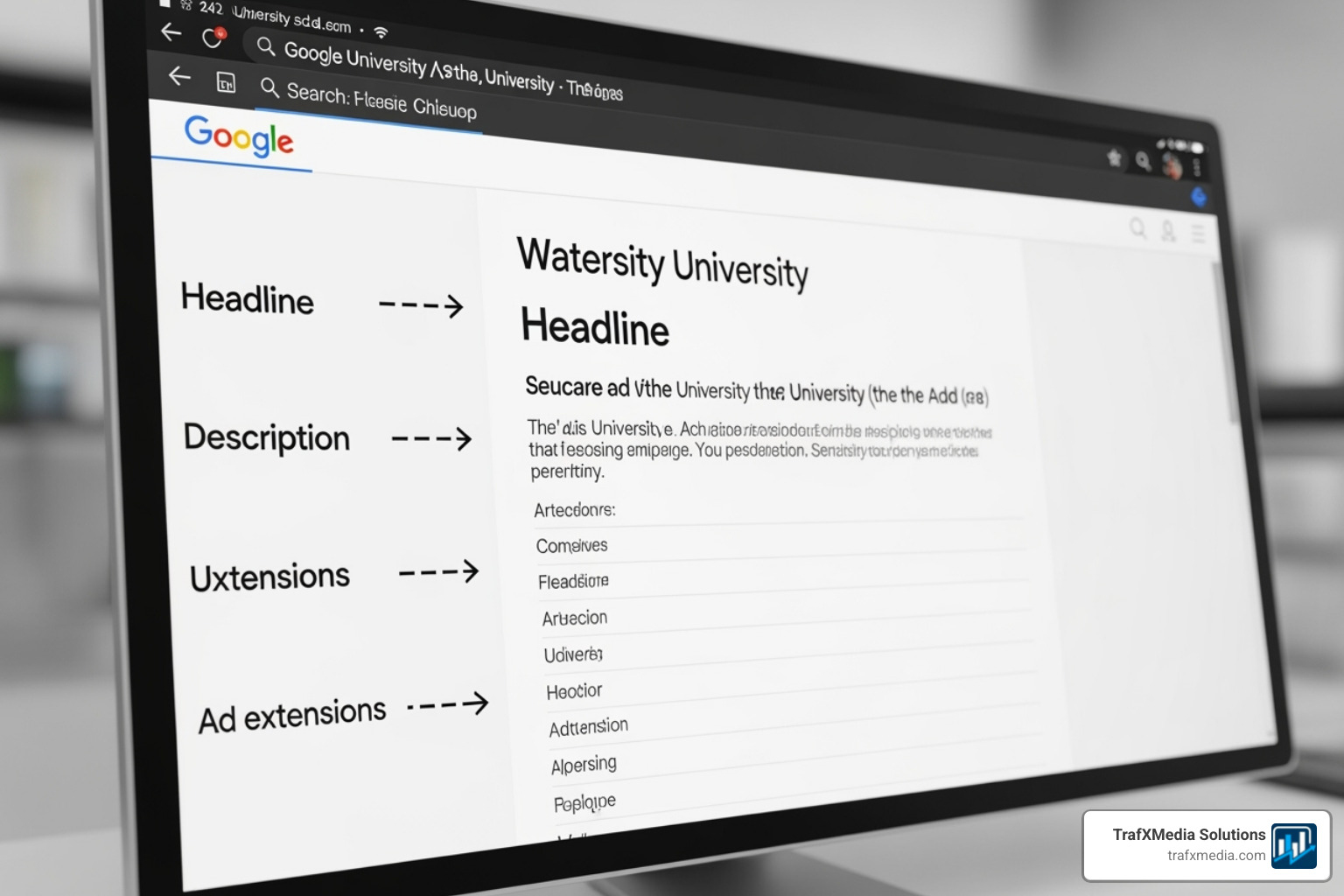
- Write Compelling, Benefit-Driven Headlines: Grab attention immediately. Instead of a generic headline like “University Programs Available,” use a powerful, benefit-focused one like “Launch Your Tech Career in 18 Months” or “95% Job Placement Rate for Graduates.”
- Highlight Your Unique Selling Propositions (USPs): What makes your institution special? Clearly communicate your key differentiators. This could be a renowned faculty, small class sizes, an innovative learning platform, flexible online schedules, or a vibrant campus community.
- Include a Clear and Strong Call-to-Action (CTA): Don’t leave users guessing. Tell them exactly what you want them to do next with action-oriented phrases like “Request a Free Program Guide,” “Schedule a Call with Admissions,” “Download Your Brochure,” or “Apply Today.”
- Connect with Emotional Triggers: Appeal to student aspirations. Frame your programs in the context of their goals, whether it’s achieving career advancement, pursuing a passion, or gaining financial stability. Speak to their hopes and address their potential concerns.
- Master Responsive Search Ads (RSAs): Accept Google’s AI. With RSAs, you provide multiple headlines and descriptions (assets), and Google’s machine learning automatically tests various combinations to find the best-performing ad for different queries and users. This automates continuous A/B testing and improves performance over time.
Leveraging Ad Extensions for Maximum Impact
Ad extensions are snippets of additional information that expand your ad’s size, making it more prominent and engaging on the search results page. They are free to add and can significantly improve your click-through rate (CTR).
- Sitelink Extensions: Add direct links to important pages on your site, such as “Admissions,” “Financial Aid,” “Program Catalog,” or “Schedule a Campus Tour.” This helps users steer directly to the information they need.
- Call Extensions: Allow mobile users to call your admissions office directly from the ad with a single tap, capturing high-intent leads who prefer to speak with someone.
- Location Extensions: Show your campus address, a map to your location, and business hours. This is crucial for attracting local students and building trust.
- Image Extensions: Add visual appeal to your text ads. Showcase compelling photos of your campus, students, or facilities to make your search ads stand out from the competition.
- Structured Snippets: Highlight specific aspects of your offerings in a structured format, such as “Degree Types: Bachelor’s, Master’s, PhD” or “Courses: Marketing, Finance, Management.”
- Promotion Extensions: Create a sense of urgency with time-sensitive offers, like “Waived Application Fee Until March 15th” or “$500 Early Enrollment Scholarship.”
- Lead Form Extensions: Capture leads directly within the search results page. Users can submit their information in a pre-populated form without ever having to visit your landing page, reducing friction significantly.
Optimizing Landing Pages for Student Applications
Your landing page is where the conversion happens. A poorly optimized page will waste your ad spend, no matter how good your ad is. Ensure it’s built for success:
- Maintain Strong Message Match: The headline, content, and offer on your landing page must directly align with the promise made in your ad. If your ad promotes a “Nursing Program,” the landing page should be exclusively about that program, not a generic homepage.
- Accept Mobile-First Design: The majority of prospective students will search and browse on their smartphones. Your page must be fully responsive, load quickly, and be easy to steer with a thumb on a small screen.
- Prioritize Fast Load Speed: Every second counts. Aim for a page load time under 3 seconds. Use tools like Google’s PageSpeed Insights to diagnose and fix issues that slow your site down, as slow pages have much higher bounce rates.
- Simplify Your Lead Capture Forms: Reduce friction by only asking for essential information initially (e.g., name, email, phone number). Long, complicated forms are a major deterrent. You can always gather more information later in the process.
- Build Credibility with Trust Signals: Reassure prospective students that they are making the right choice. Prominently display trust signals like student testimonials, video interviews, university accreditations, faculty credentials, partner company logos, and employment statistics.
- Continuously A/B Test: Never stop optimizing. Systematically test different elements of your landing page—such as headlines, hero images, call-to-action button colors, form lengths, and testimonials—to identify what works best and continuously improve your conversion rate.
Smart Budgeting, Bidding, and Advanced Strategies
Effective management of Google ads for education requires a strategic approach to budgeting and bidding to maximize impact and ensure every dollar is invested wisely. Google Ads provides comprehensive control over your spending, allowing you to align your investment directly with your student recruitment goals.

Managing Budgets and Bidding Effectively
You control your costs by setting an average daily budget for each campaign. Google’s system will then manage your spending across the month, ensuring you don’t exceed your monthly charging limit (your daily budget multiplied by 30.4). When it comes to bidding—how much you’re willing to pay for a click or conversion—you have two main approaches:
- Manual Bidding: This gives you the most granular control. With Manual CPC, you set the maximum cost-per-click (CPC) you’re willing to pay for each ad group or keyword. You can also use Improved CPC (eCPC), which allows Google to make minor automatic adjustments to your manual bids for clicks that seem more or less likely to lead to a conversion.
- Automated Bidding (Smart Bidding): This strategy leverages Google’s AI to adjust bids in real-time to meet specific campaign goals. Popular strategies for education include:
- Maximize Conversions: Aims to get the most inquiries or applications possible within your set budget. Ideal for lead generation.
- Target CPA (Cost Per Acquisition): You set a specific target cost for each lead (e.g., $50 per inquiry form submission), and Google’s AI works to achieve that average cost.
- Target ROAS (Return on Ad Spend): If you can assign a monetary value to your conversions, this strategy aims to achieve a specific return on your ad spend.
- Maximize Clicks: Aims to drive as much traffic to your website as possible within your budget. Useful for building brand awareness or feeding your remarketing lists.
Google offers a variety of bid strategies to align with nearly any marketing objective.
Re-engaging Prospects with Remarketing
Most prospective students don’t inquire or apply on their first visit to your website. The decision-making process is long and complex. Remarketing (or retargeting) is a powerful strategy to stay top-of-mind and reconnect with these interested prospects who have already shown an interest in your institution.
- Standard Remarketing Lists: Create audiences based on user behavior. For example, you can create separate lists for users who visited your undergraduate program pages versus your graduate program pages. Then, you can deliver highly relevant display or video ads with custom messaging to each group as they browse the web or watch YouTube.
- RLSA (Remarketing Lists for Search Ads): This is a particularly powerful technique. It allows you to tailor your search campaigns for past website visitors. You can increase your bids when they search again on Google, ensuring you appear in a top position, or show them specialized ad copy that acknowledges their prior visit (e.g., “Still Considering Our MBA Program?”).
- Dynamic Remarketing: Go a step further by showing past visitors ads that feature the specific programs or courses they viewed on your site. This highly personalized approach can be extremely effective.
- Customer Match: Upload lists of email addresses or phone numbers (e.g., from event sign-ups or unfinished applications) to target these specific users with ads across Google’s network, re-engaging them at different touchpoints.
The Role of AI in Modern Education Campaigns
Artificial intelligence is no longer a futuristic concept; it’s a core component that is revolutionizing Google ads for education by automating complex tasks and optimizing campaigns at a scale beyond human capability.
- Performance Max Campaigns: As mentioned, these AI-driven campaigns test your assets (text, images, videos) across all of Google’s platforms to find the best placements and automatically allocate budget to maximize results based on your conversion goals.
- Optimized Targeting: AI analyzes vast amounts of user data to identify patterns and predict which prospects are most likely to apply. It can then reach users who fit the profile of your ideal student, even if they aren’t in your manually selected audience segments.
- Smart Bidding: This AI-powered feature is the engine behind automated bidding. It continuously adjusts bids for every single auction based on hundreds of real-time signals, including the user’s device, location, time of day, browser, language, and specific search query. This level of real-time optimization is impossible to achieve manually. The Google Ads AI Essentials help page offers more insight into these powerful features.
Measuring Success and Integrating Your Efforts
The primary and most powerful advantage of Google ads for education over traditional advertising is its inherent transparency and measurability. You can track every click, conversion, and dollar spent, providing you with a wealth of actionable data. This allows for continuous, data-driven optimization to improve performance and maximize your return on investment.
Key Metrics for Tracking Performance
To measure success effectively, you must focus on the key performance indicators (KPIs) that truly matter for student recruitment. Vanity metrics like clicks are not enough; your focus should be on generating qualified student inquiries.
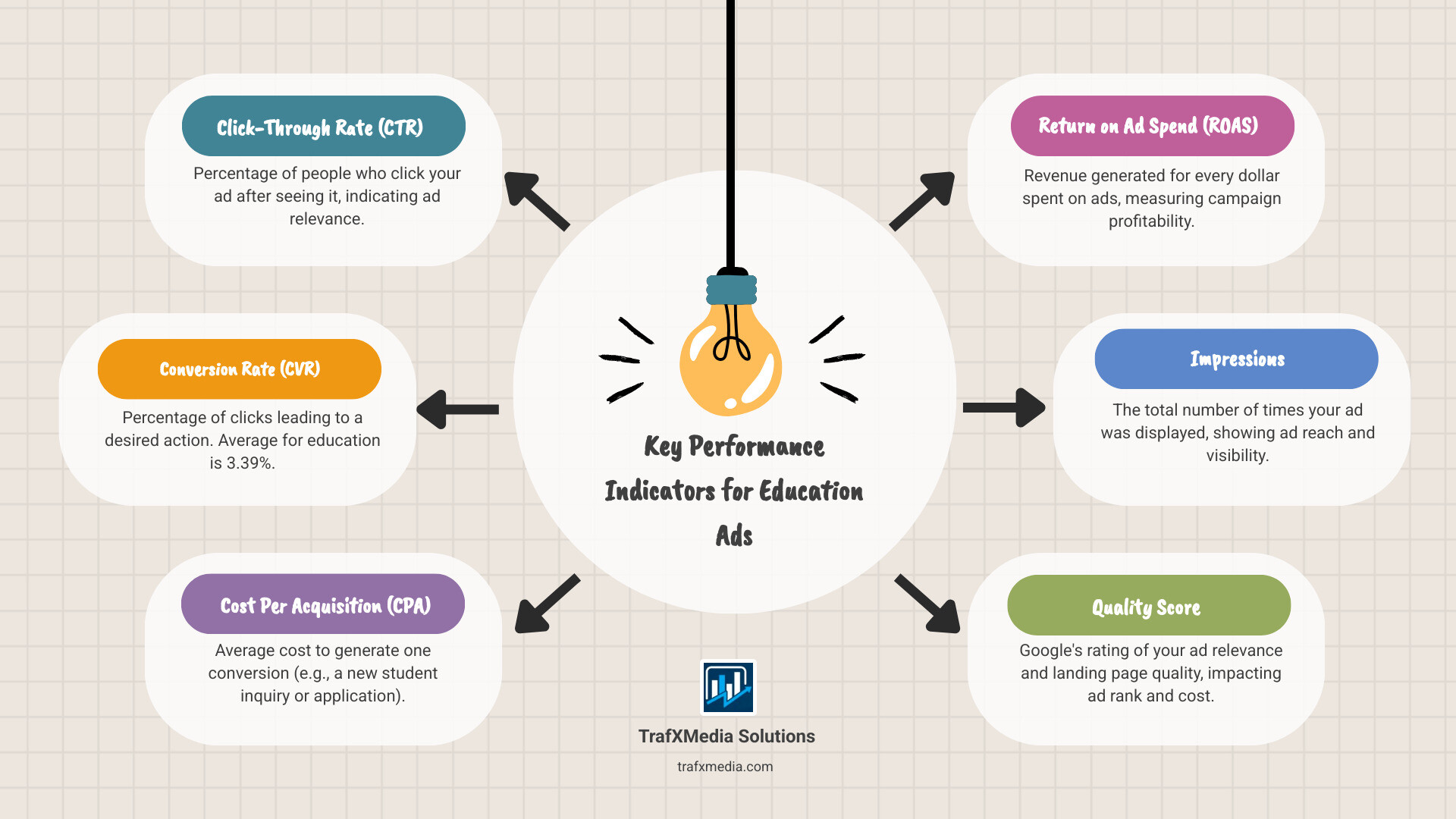
- Click-Through Rate (CTR): The percentage of impressions that result in a click (Clicks ÷ Impressions). This measures how compelling and relevant your ads are. A high CTR indicates your message is resonating with your target audience.
- Conversion Rate (CVR): The percentage of clicks that result in a desired action, such as an inquiry form submission, a phone call, or an application start. The education sector’s strong average of 3.39% on Search highlights the high intent of users.
- Cost Per Acquisition (CPA): Also known as Cost Per Lead (CPL). This is the average cost to generate one qualified lead (Total Cost ÷ Conversions). This is arguably the most important metric for revealing the true efficiency of your ad spend.
- Return on Ad Spend (ROAS): This metric connects ad spend directly to revenue. While challenging to track in education due to long conversion cycles, it can be estimated by assigning a value to each lead based on historical enrollment rates and average tuition value.
- Impression Share (IS): This metric shows the percentage of impressions your ads received compared to the total number of impressions they were eligible to get. It’s a key indicator of your visibility and market share against competitors.
- Quality Score: Google’s 1-10 rating of your ad, keyword, and landing page relevance. A higher score is critical as it leads to lower costs and better ad positions.
To track these metrics accurately, it is absolutely essential to set up Conversion Tracking correctly. This is typically done by placing a Google Ads tag on your “thank you” pages or by importing conversion goals from Google Analytics.
Integrating Google Ads with SEO and Social Media
For maximum impact, Google Ads should not operate in a silo. The most successful institutions create a unified, holistic digital presence where all marketing channels work together synergistically.
- Consistent Branding and Messaging: Ensure your brand’s story, value propositions, and visual identity are consistent across your Google Ads, website, social media profiles, and email marketing. This builds trust and reinforces your message at every touchpoint.
- Powerful SEO and Google Ads Synergy: Use Google Ads for immediate visibility and lead generation while you build long-term organic authority with Search Engine Optimization (SEO). The keyword data from your Google Ads campaigns (e.g., which terms convert best) can provide invaluable insights to inform your SEO content strategy. Conversely, a strong SEO foundation with well-optimized landing pages can improve your ad Quality Scores, lowering your ad costs.
- Social Media Amplification: Use social media platforms like Facebook, Instagram, and LinkedIn for top-of-funnel brand awareness campaigns. You can then use Google Ads to capture the demand you’ve created, targeting users who search for your institution or programs after seeing your social content.
- Shared, Optimized Landing Pages: Create a seamless user experience by directing traffic from all your marketing channels—paid search, social media, email—to the same high-converting, dedicated landing pages. This ensures consistency and maximizes your conversion opportunities.
- CRM Integration for Full-Funnel Tracking: For the ultimate measurement of success, integrate your Google Ads account with your Customer Relationship Management (CRM) system (like Slate, Salesforce, or HubSpot). This allows you to track which keywords and campaigns are generating not just leads, but actual applications and enrolled students, giving you a true, closed-loop picture of your ROI.
- Granular UTM Tracking: Use UTM parameters in your ad destination URLs to pass detailed campaign information into Google Analytics. This helps you understand precisely how users from different campaigns and ad groups behave on your site, providing deeper insights into which channels drive the most valuable engagement.
Frequently Asked Questions about Google Ads for Education
Here are detailed answers to some of the most common questions and concerns from educational institutions starting on or looking to optimize their Google ads for education campaigns.
What are the most common challenges for schools using Google Ads?
Institutions of all sizes often face several recurring challenges that can hinder campaign success if not addressed proactively:
- Strict Budget Constraints: Schools, especially non-profits and public universities, typically operate with tight marketing budgets. This makes it absolutely crucial to maximize every dollar. Success requires a relentless focus on efficiency through smart bidding, a robust negative keyword strategy to eliminate waste, and targeting the most valuable prospects.
- Limited Time and Internal Resources: Managing Google Ads effectively is not a “set it and forget it” task; it requires ongoing monitoring, analysis, and optimization. Many in-house marketing teams are small and juggle numerous responsibilities, making it difficult to dedicate the necessary time. Prioritizing high-impact activities and leveraging automation are key.
- Long and Complex Conversion Cycles: The journey from a student’s first exploratory click to a submitted application and final enrollment can take weeks or even months. This long consideration phase makes it challenging to measure the true ROI of a campaign quickly. Implementing proper conversion tracking and using appropriate attribution models (beyond last-click) are essential to see the full picture.
- Intense Competition: Keywords for popular and lucrative programs like “MBA,” “nursing degrees,” or “law school” can be extremely competitive and therefore expensive. Success often requires a sophisticated strategy that balances bidding on these broad, high-volume terms with a focus on more specific, less competitive long-tail keywords that indicate higher intent.
- Pronounced Seasonality: Search interest for academic programs is not constant; it fluctuates predictably throughout the year, peaking during key application and enrollment periods. Budgets and campaign strategies must be planned around these enrollment cycles, scaling up during peak seasons and pulling back during quieter times to maintain efficiency.
How can our team improve its Google Ads expertise?
Building and maintaining expertise is an ongoing process in the changing world of digital advertising. Here are some excellent resources:
- Google Skillshop: This is the best starting point. Google offers free, comprehensive online training courses and certifications on all aspects of Google Ads, from search fundamentals to advanced video and display strategies. Visit Skillshop to get started.
- Official Google Ads Help Center: An invaluable and authoritative resource for troubleshooting specific issues, understanding new features, and reading detailed guides on every facet of the platform.
- Industry Blogs and Publications: Follow reputable digital marketing blogs like Search Engine Land, WordStream, and PPC Hero. They provide daily news, analysis, and actionable tips from industry experts.
- Community Forums and Groups: Learn from the real-world experiences of other marketers. Participate in forums like Reddit’s r/PPC or specialized LinkedIn groups to ask questions and share insights specific to the education sector.
- Continuous Learning: The platform changes constantly. Dedicate a few hours each month to reading about new features, watching webinars, and experimenting with new strategies to keep your campaigns competitive and effective.
How does performance vary across different campaign types?
Different campaign types are designed for different goals, and their performance metrics will reflect that. A successful, integrated strategy often combines multiple campaign types to engage students at every stage of their journey.
- Search Campaigns: These are your primary lead generators. They deliver the highest-intent traffic from users actively seeking educational solutions. They typically have the highest conversion rates and CPA but deliver the most qualified leads.
- Display Campaigns: Excellent for building top-of-funnel brand awareness and for remarketing to past website visitors. They generally have a much lower cost-per-click (CPC) and can generate a massive number of impressions, but their direct conversion rates are typically lower than Search.
- Video Campaigns (YouTube): Ideal for creating emotional connections and showcasing your campus culture. They are great for building awareness and consideration. Key metrics here are often View Rate and Brand Lift, rather than direct conversions.
- Performance Max Campaigns: These AI-driven campaigns aim to maximize results across all channels. They are most effective when you have clear conversion goals, a sufficient budget for the AI to learn, and high-quality creative assets (images, videos, and text). They offer less manual control but can be extremely efficient at finding converting users.
Is Google Ads too expensive for a small school?
This is a common concern. While highly competitive keywords can be expensive, the cost is relative to the value. The beauty of Google Ads is its scalability and control. A small school can start with a modest budget focused on very specific long-tail keywords and tight geographic targeting (e.g., “evening accounting classes in [Your City]”). The platform’s efficiency and high ROI potential often make it one of the most cost-effective marketing channels available when managed correctly, allowing smaller institutions to compete effectively for their niche audiences.
Conclusion
Successful Google ads for education campaigns do more than just generate clicks; they build a vital and dynamic bridge between your institution and the students who are actively searching for the unique programs you offer. Achieving this requires a holistic and strategic approach, one that is carefully planned, precisely targeted, and relentlessly optimized based on actionable data.
Throughout this guide, we’ve covered the core pillars of success that transform an average campaign into a powerful engine for enrollment growth. These pillars include strategic campaign planning with a logical structure, precise audience targeting to reach the ideal student, compelling ad creative and landing pages that resonate and convert, and smart, AI-powered bidding and optimization to maximize ROI. By mastering these essential elements, educational institutions can fully leverage Google’s unparalleled reach and capitalize on the education sector’s naturally high conversion rates to gain a significant and sustainable competitive advantage.
Google Ads performs best when it is not an isolated activity. Integrating your paid search efforts with your broader marketing ecosystem—from organic SEO and content marketing to social media and CRM systems—creates a powerful synergy that amplifies your message, builds brand trust, and provides a complete view of the student journey.
At TrafXMedia Solutions, we understand that every college, university, and vocational school has unique goals, distinct student profiles, and specific budget realities. Our personalized, data-driven approach to Google ads for education ensures your campaigns are custom to your specific needs, driving meaningful and measurable growth.
The modern student journey is complex and multifaceted. However, with the right strategy, deep expertise, and a commitment to continuous improvement, you can create powerful campaigns that not only drive inquiries but also build lasting relationships with your future student body.
Ready to transform your student recruitment and achieve your enrollment targets? Let’s work together to build campaigns that deliver real, tangible results.
Get expert help with your Google Ads campaigns in San Francisco